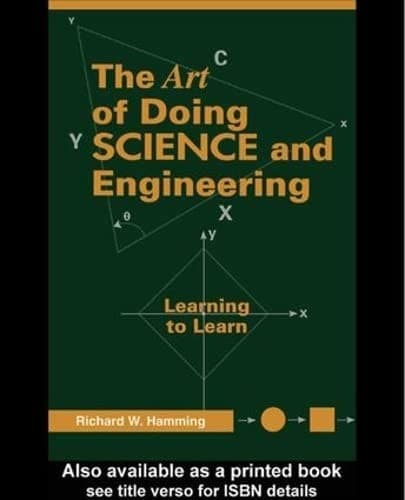
Core Idea
- Vision drives linear progress; drifting produces √n progress—define your own goals of excellence and prepare continuously for opportunities
- Master fundamentals deeply, not surface facts—depth enables you to recognize patterns others miss and adapt as knowledge doubles every ~17 years
- Study method, not just results—how great scientists solved problems matters more than what they discovered
Vision & Strategic Direction
- Schedule regular "big picture" time (e.g., Friday afternoons) away from daily tasks to reflect on larger directions
- Hold 10-20 important unsolved problems in mind constantly; drop quickly if sterile
- Ask "What's the real problem?" before solving symptoms—reframe to unlock better solutions
- Anticipate technological shifts before they arrive; prepare your mind for changes you can't fully predict
Learning & Expertise
- Distinguish between education (what, when, why) and training (how)—both are essential
- Learn the jargon of other fields but resist letting it limit your thinking; use as a tool, not a prison
- Don't become an expert drag on progress—stay aware that what made you successful becomes counterproductive
- Keep current constantly; experts who don't adapt are left behind
Problem-Solving & Innovation
- Simplify problems to fundamentals before adding complexity; remove extraneous details
- Question accepted doctrine; verify that "impossible" claims still hold given changed circumstances
- Great innovations come from outside the field—stay open to "crackpot" ideas from outsiders
- Saturate your subconscious with important problems; temporary abandonment often precedes breakthrough insights
Design & Systems Thinking
- When mechanizing processes, design an equivalent product, not an identical replica
- Build feedback into designs to tolerate inaccurate components; let feedback compensate for errors
- Design systems for graceful degradation, not just hitting specifications—over-optimized designs fail when overloaded
- Never optimize components in isolation; you will degrade overall system performance
- Build flexibility into designs; anticipate changes you can't foresee
Measurement & Quality Control
- You get what you measure—choose metrics carefully; poorly chosen measures create perverse incentives
- Question all claimed accuracies; independently verify data reliability (90% of measurements fall outside stated confidence limits)
- Watch how measurement systems affect behavior; install safeguards against gaming the metrics
- Question simulation outputs; large computers and pretty printouts don't guarantee validity
Work Execution & Influence
- Sell your ideas three ways: formal presentations, written reports, informal conversations—all three mandatory
- Give credit freely and share ideas openly—ideas spread your influence; secrecy restricts it
- Help others succeed; recognition follows naturally from cooperation
- Choose important problems worth solving; most scientists waste time on trivial work
- The effort matters more than the result; the person you become through striving is the true gain
Personal Responsibility & Growth
- You are responsible for your decisions—don't defer accountability to committees or authority
- Change yourself deliberately; you are the sum of your habits; small habit shifts compound over decades
- Plan your future explicitly; drifting produces √n progress, vision produces linear progress
- Don't become essential to your current role; that blocks promotion and locks you into the past
Action Plan
- This week: Define 3 clear personal goals of excellence; schedule recurring "vision time" (minimum 2 hours/week) for strategic thinking
- This month: Identify 10 important unsolved problems in your field; study how 3 great practitioners solved similar problems (method, not just results)
- This quarter: Audit your measurement systems—are your metrics creating perverse incentives? Redesign one metric to reward the behavior you actually want
- Ongoing: Master one fundamental principle deeper than peers; learn jargon in adjacent fields; question one "impossibility" claim with fresh assumptions
Generated with Claude Sonnet 4.6 · prompt legacy-pre-v6 · model inferred from repository history