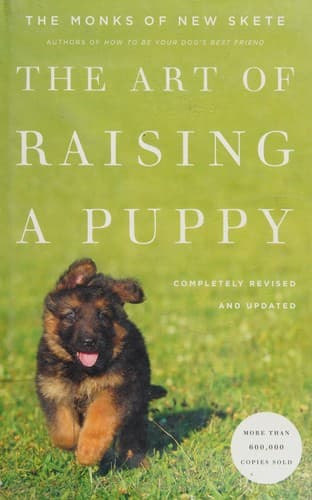
Core Idea
- The book’s central claim is that puppy raising is a moral and practical craft, not a casual purchase: the dog’s later behavior, health, and bond with humans are largely shaped by the first weeks and months.
- The authors treat dogs as pack-oriented, emotionally real beings with needs for companionship, structure, exercise, and thoughtful stewardship, not as possessions or children’s toys.
- A good relationship with a dog begins with responsible breeding, careful placement, early socialization, and immediate training, because problems prevented early are vastly easier than problems corrected later.
Development, Socialization, and Breed Fit
- The opening chapters trace a puppy’s development from birth through the critical early weeks, using Anka’s litter to show the mystery of whelping, neonatal helplessness, and the breeder’s role in protecting life.
- They borrow heavily from Scott and Fuller to divide development into neonatal, transitional, socialization, and juvenile stages, while insisting that scientific generalizations never erase the individuality of each dog.
- The first 16 weeks matter most; especially the critical period of socialization from roughly 3 to 12 weeks, when experience can shape adult temperament in lasting ways.
- Early handling is not just about exposure but about the right kind of exposure: mild stress, touch, brief separation, grooming, and varied human contact are used to build resilience rather than fear.
- The authors warn against overloading very young puppies, especially before the nervous system is ready, and they emphasize that the later fear/avoidance period can make a previously confident pup seem cautious again.
- Socialization is split into two phases: an early phase focused more on dogs and litter learning, and a later phase that expands toward people, places, objects, sounds, and household life.
- They stress that puppies need both species-typical dog learning and human familiarity; too little contact with either can produce fearfulness, poor manners, or dog-directed problems later.
- A major placement rule is that the puppy must fit the owner’s life: temperament, size, maturity rate, energy level, and work potential matter more than abstract “best dog” claims.
- The authors prefer purebreds for predictability and responsible breeding, but treat mixed-breed dogs as equally deserving of care; the dog’s needs do not become less because its ancestry is mixed.
- They strongly discourage pet shops and puppy mills, which they describe as profit-driven systems that produce poorly socialized, often stressed, unhealthy puppies with little trustworthy background information.
- Shelters are viewed more sympathetically than pet shops but still require caution because early history and health may be unknown.
- Good breeders should provide pedigree, health and temperament information, and ongoing support, and they should match puppies to homes rather than simply sell them to buyers.
- Sex matters less than many people assume: the authors reject broad claims that males or females are inherently better, though they note typical tendencies such as female dogs maturing faster and males being more self-assertive.
- Breed choice must be honest about the owner’s reality: the book repeatedly asks whether the household can truly supply the daily walking, exercise, training, grooming, and attention a dog needs.
Training, Discipline, and House Life
- Training begins immediately, not at six months, and it is framed as part of the puppy’s entire life, not a narrow obedience drill.
- The authors’ style emphasizes leadership through body language, eye contact, calm correction, and consistent routines, rather than anger or dominance for its own sake.
- They reject treat-centered training as the basis of the relationship, arguing that praise, touch, and the owner’s attention should be the primary rewards.
- Early handling exercises teach the puppy to accept restraint, mouth and ear examination, full-body massage, and repositioning so grooming, vet care, and control are not battles later.
- Core obedience begins with loose leash, Sit, Down, Stay, Come, and Heel, taught briefly and pleasantly, with progress built step by step.
- Corrections are meant to be immediate and informative, not delayed punishment; they recommend leash pops, brief scruff discipline, and similar interventions only as needed, then immediate return to praise.
- They repeatedly warn against mistakes that poison training: calling a puppy to punish it, repeating cues endlessly, using constant leash tension, or allowing recall to become associated with bad outcomes.
- House-training depends on a strict schedule, confinement when unsupervised, prompt trips outside, and thorough odor removal so the same spot does not become a permanent elimination cue.
- Crates are defended as humane den-like tools for house-training and safety, not as punishment, and the puppy should be introduced to them gradually and positively.
- The book also covers common behavior issues such as mouthing, chewing, jumping up, possessiveness, submissive urination, and carsickness, treating most of them as predictable developmental patterns that can be shaped early.
- Chewing is addressed through prevention, redirection, and management; jumping is treated as face-licking behavior made rude in human settings; possessiveness is corrected before it hardens into aggression.
- Feeding, grooming, and exercise are all part of training: puppies need scheduled meals, regular brushing, nail clipping, ear care, safe bathing, and enough age-appropriate exercise to avoid destructive boredom.
The Dog–Human Bond
- The final sections widen the book from technique to relationship: a well-raised dog can become a helper, companion, mirror, and teacher.
- Buck, the therapy dog, illustrates the book’s ideal of a “total dog”: not merely obedient, but deeply attached, practically useful, and emotionally responsive to his people.
- Buck’s work with Len and Betty Cohen shows how a well-matched dog can support disability, independence, household tasks, emotional steadiness, and even emergency protection.
- The authors also use dogs in children’s lives, especially in illness or hardship, to show how a dog’s steady presence can restore confidence, responsibility, and a sense of being known.
- Maurice Sendak’s reflections present dogs as honest companions that can reveal a person’s temperament and habits; the dog becomes a partner in self-knowledge, not just a pet.
- The epilogue frames dog ownership as a way back into reverence, humility, and attention to the nonhuman world, arguing that dogs can draw people out of self-absorption and into a larger moral order.
What To Take Away
- The book’s deepest message is that good dogs are made, not found, through breeding choices, early care, and patient human commitment.
- The authors’ practical rules are all in service of one idea: a puppy thrives when its world is structured, social, and honest.
- Their standard for ownership is high because the stakes are high: a poorly raised puppy can become a lifelong problem, while a well-raised one can become a remarkable companion.
- The book ultimately treats dog raising as a test of character: how you raise the puppy reveals how seriously you understand responsibility, companionship, and love.
Generated with GPT-5.4 Mini · prompt 2026-05-11-v6