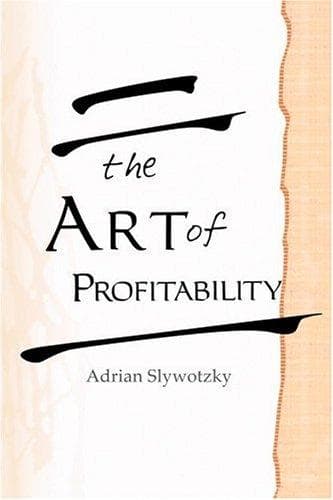
Core Idea
- The book argues that profit is not one thing: it comes from distinct profit models, and the central management task is to recognize which model fits your business, customer, and industry structure.
- Its recurring premise is that the path to profit runs through deep understanding of the customer, but the right profit mechanism can also come from speed, scale, control points, standards, installed base, specialization, or digital design.
- Zhao teaches these models as a way of thinking: some businesses create profit by owning a customer problem, others by owning a bottleneck, a standard, a time window, or a repeated asset.
Customer, Channel, and Asset-Based Models
- Customer Solution Profit means learning a customer so thoroughly that you can create a tailored solution, often losing money early and profiting later as the product becomes embedded; Factset is the model case, and Delmore is warned not to drift into a no-profit zone by ignoring it.
- Multi-Component Profit recognizes that one underlying business can contain very different economics by channel or use-case; Coca-Cola’s grocery, restaurant, and vending businesses are different businesses in practice, and Burton helped bookstores build higher-margin corporate, book-group, and heavy-buyer components.
- Switchboard Profit comes from assembling enough talent, stories, or relationships that others must come to you; Michael Ovitz’s advantage depended not just on packaging talent but on reaching a critical scale that changed bargaining power and deal flow.
- Profit-Multiplier is different: one asset, story, or character is reused into many distinct products, as with Disney film, Broadway, DVD, merch, games, and attractions.
- Installed Base Profit comes from the recurring consumables and follow-on sales attached to a hardware base; the key is managing the post-sale stream well instead of letting others capture it.
- After-Sale Profit extends that logic: a big initial purchase creates a new minimarket for required extras, and the seller often leaves this profit on the table because the organization is built around the initial sale, not the repeat sale.
- De Facto Standard Profit works because the market becomes more predictable and the customer, not the vendor, does much of the marketing; Microsoft, Oracle, and IBM illustrate how standards also create upgrade, application, and planning advantages.
- Brand Profit is a separate force: a product can command a premium because of accumulated trust, image, and advertising history, and the book stresses first-hand observation, not abstract assumption, as the way to understand what the brand really means.
- Specialty Product Profit rests on unique, often patented offerings with high margins, but the model can erode as the specialty space commoditizes, forcing the company to shift toward cost, cycle, and portfolio management.
Control, Scale, and Timing Models
- Value Chain Position Profit says some places in the chain are control points where profit and power concentrate; these positions may be inherited or created, and the profit comes from predictability, pace-setting, and forcing others to react.
- Cycle Profit ties profit to utilization: as fixed assets are used more fully, unit costs fall and pricing power improves, so the business moves from negative profit to break-even to strong profit as the cycle fills.
- Experience Curve Profit shows how cumulative volume can drive down direct labor, materials, and energy costs, but the book warns that overhead can rise if management is not disciplined; the danger is overfocus and loss of peripheral vision.
- New Product Profit is the early S-curve rush, when a new product has both high growth and high margins; the managerial discipline is to invest heavily early, then harvest and shift resources before the peak.
- Time Profit says innovation creates a shrinking window before imitation arrives, so speed, instant diffusion, and organization-wide execution matter; Waterstone’s crash launch process is the model, and tedium is identified as the great enemy.
- Blockbuster Profit focuses on the small number of projects that can matter; Geron’s work emphasizes front-end loading, ruthless project sorting, backups for lead projects, and the idea that many projects are “antiprofit” if they lack a meaningful target.
- Specialist Profit comes from sequential specialization in one domain, which yields lower delivery cost, better reputation, shorter sales cycles, faster penetration, and the ability to reuse the same solution many times at very high margin.
- Entrepreneurial Profit is a culture model: super-frugality, speed, experimentation, close attention to costs, and a constant willingness to copy, test, cut, and reallocate resources toward what works.
- The book repeatedly warns that success can destroy these models if large organizations become complacent, subsidize nonentrepreneurial behavior, or fail to notice where the real economics have moved.
Digital, Arithmetic, and Anticipation
- Digital Profit is presented as a discontinuity that can add around 10 points to the bottom line by shifting work to customers, improving real-time information, and turning push systems into pull systems.
- Its examples include Dell’s configurator, Cemex’s response-time collapse, Oracle’s lower service cost, Cisco’s self-service FAQ handling, and customer-designed choiceboards.
- Zhao’s deeper claim is that much poor profitability comes from bad information; digital changes the economics because it changes who knows what, when, and at what cost.
- The book also treats fast arithmetic as a managerial discipline: rough estimation first, then refinement only if warranted, so numbers can expose bad plans and test whether a story is plausible.
- Underneath the models is a broader lesson about anticipation: durable business designs no longer last decades, so firms must recognize pattern shifts early enough to build the next runway before the current model fades.
What To Take Away
- The book’s main contribution is a catalog of profit logics that are not interchangeable; the same company may need to think in several models at once.
- Many of the strongest models depend less on size than on structure: control points, installed bases, standards, specialization, and the ability to shape customer behavior.
- The author’s practical test is always the same: ask where the profit really comes from, who controls the pace, what the customer will actually pay for, and what the business is blind to.
- The biggest failure mode across the book is organizational inertia: companies often know the recipe for profit but resist the mindset, discipline, or redesign required to keep earning it.
Generated with GPT-5.4 Mini · prompt 2026-05-11-v6