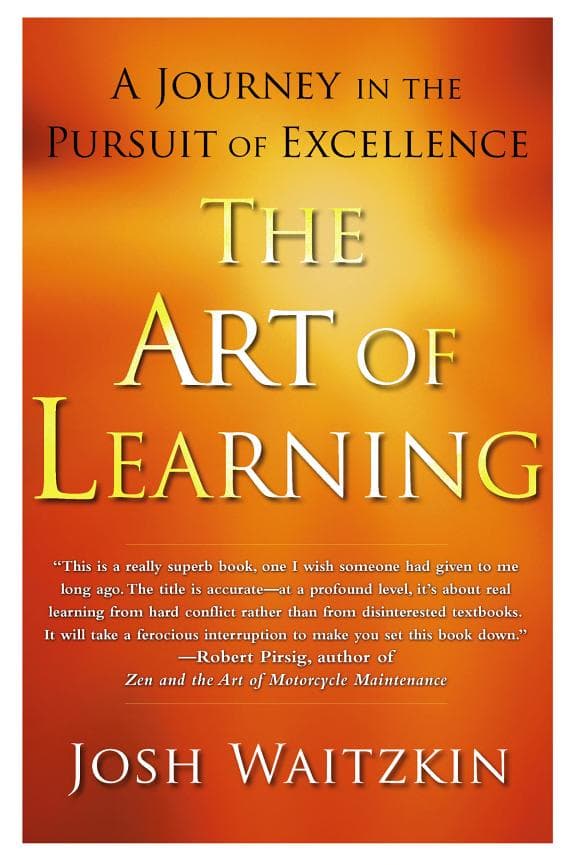
Core Idea
- Waitzkin presents his life as one long investigation into how people learn, arguing that excellence in chess, Tai Chi, and performance comes from understanding the same underlying process rather than from talent alone.
- His central claim is that durable mastery requires turning knowledge into embodied intuition: study fundamentals deeply, internalize them through repetition and pressure, and then let them disappear into instinct and flow.
- The book’s stakes are personal as well as competitive: fame, results, and external validation can easily damage one’s relationship to the work unless learning remains the real aim.
Learning, Mindset, and Foundations
- Waitzkin’s early chess education combined two worlds: the street toughness of Washington Square Park and the disciplined, trust-based coaching of Bruce Pandolfini.
- Bruce taught by asking questions, preserving Josh’s voice, and proving principles through play rather than lecturing, which helped Josh become analytical instead of dependent.
- A recurring warning is against teaching children to chase short-term wins, memorize openings, or seek praise as proof of being “smart,” because that encourages an entity theory of intelligence.
- Drawing on Carol Dweck, he contrasts entity theorists—who see ability as fixed and become brittle under failure—with incremental/learning theorists, who treat challenge as a path to growth.
- His own training emphasized endgames and fundamentals first so he could feel the pieces, understand structure, and later build openings on a deeper foundation.
- He repeatedly argues that results matter, but only when they are embedded in a larger process-first framework that still exposes the learner to real pressure.
- The “hermit crab” metaphor captures growth: mastery requires leaving an old shell, entering an awkward in-between state, and adapting to a new form.
Performance States and Learning Under Pressure
- Waitzkin develops the distinction between the Hard Zone and the Soft Zone: the Hard Zone breaks when reality does not cooperate, while the Soft Zone stays flexible, relaxed, and responsive under chaos.
- He trains this state by working amid distractions—noise, music, chants, rough chess clubs, and public pressure—until disturbance becomes usable rather than disruptive.
- A related problem is the downward spiral, when one mistake triggers panic, self-protection, and compounding errors; recovery requires presence, breath, and rapid reset.
- He uses examples like the taxi-accident analogy and his student Ian’s saved game to show that composure can be restored quickly if the player notices the emotional slide.
- In Tai Chi Push Hands and in chess, he treats investment in loss as essential: you must allow yourself to be thrown, embarrassed, or structurally disadvantaged in order to discover better responses.
- He rejects the idea that resilience is merely stoicism; instead, it is the ability to transform discomfort, injury, or chaos into sharper focus and better timing.
- The book also stresses that top performers must not hide from outcomes entirely: sheltering from pressure can become stunting, because growth happens where risk is real.
Condensation, Intuition, and the Hidden Structure of Skill
- One of the book’s key technical ideas is “Making Smaller Circles”: take a complex skill, isolate the essence, reduce the motion or decision space, and preserve power while shrinking visible effort.
- In Tai Chi this means tiny, precise movements that reveal internal tensions, teach relaxation, and eventually make the whole form feel natural and powerful.
- In chess, the same logic appears in reduced endgames and simplified positions that expose core principles like tempo, opposition, zugzwang, and structure.
- Waitzkin argues that learning is often a move from conscious effort to chunking and pattern recognition, where the mind groups relationships and sees more while consciously handling less.
- He uses the language of “numbers to leave numbers” and “form to leave form” to describe deep study that eventually transcends explicit calculation.
- Expert performance, in his view, depends on the unconscious processing a much larger field than the conscious mind can manage; training carves neural pathways that make perception faster and denser.
- His judo and Push Hands examples show how a move first appears as blur, then becomes analyzable in micro-steps, and then returns to spontaneity with greater depth.
- He insists that “magic” is usually just a technical and psychological process not yet broken down well enough.
Tai Chi, Intention, and the Taiwan Championship
- Tai Chi became a way out of chess pressure because it returned him to beginnerhood, bodily awareness, and humility, with William C. C. Chen as a model of quiet precision and personal teaching.
- Breath is central in Tai Chi for him: inhalation and exhalation become a rhythm for expansion and release, restoring a body long held tight by chess tension.
- In Push Hands, Chen’s apparent softness hides a devastating understanding of leverage, structure, and timing; the point is to defeat force by nonresistance rather than opposition.
- He extends the chess idea of reading “tells” into martial arts, arguing that intention can be felt in posture, weight shift, breathing, and subtle first movements.
- The 2004 Taiwan World Championships become the fullest test of these ideas: last-minute rule changes, altered ring dimensions, bad calls, and brutal pacing forced him to adapt rather than complain.
- In Fixed Step, he relied on condensed structure and the bear hug; in Moving Step, he used pummeling, double outside position, and timing to turn a weakness into a strategic advantage.
- The event ends with a shared title in Moving Step after a disputed final, and Waitzkin treats the experience as both thrilling and unsettling because it revealed a more gladiatorial part of himself.
What To Take Away
- Mastery is not just about accumulating techniques; it is about digesting them until they become part of perception, timing, and instinct.
- The best learners stay attached to process without becoming soft about pressure, because real improvement requires exposure to failure and resistance.
- Style matters: the author repeatedly defends preserving a person’s natural voice while refining it, rather than forcing everyone into one system.
- The deepest lesson is that excellence comes from making yourself adaptable enough that surprise, chaos, and discomfort can be turned into learning.
Generated with GPT-5.4 Mini · prompt 2026-05-11-v6