Core Idea
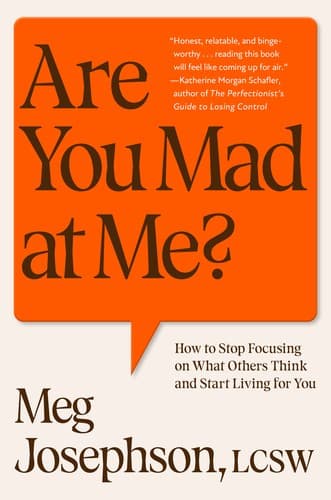
- Are You Mad at Me? argues that chronic people-pleasing is often not a personality flaw but a trauma-shaped survival strategy, especially the fawn response: moving toward perceived threat by becoming more agreeable, helpful, and easy to please.
- The book’s central concern is that what once protected you can later trap you in hypervigilance, self-abandonment, and compulsive attention to other people’s moods, texts, reactions, and approval.
- Healing is framed as learning internal safety, tolerating emotion and sensation, and building self-trust without waiting for other people to change or finally validate your pain.
How Fawning Works
- Josephson treats fawning as one of the nervous system’s adaptive responses alongside fight, flight, and freeze, not as a fixed identity or moral failing.
- She links adult anxiety about being disliked to childhood environments where emotional cues had to be monitored for safety, so “Are you mad at me?” becomes an embodied survival question.
- The book emphasizes that trauma is a nervous-system experience, often built from repeated “small” moments, chronic unpredictability, and what was missing as much as what happened.
- She names common fawn roles: Peacekeeper, Performer, Caretaker, Lone Wolf, Perfectionist, and Chameleon, each describing a different way children adapt to relational threat or neglect.
- These patterns often show up as overexplaining, overapologizing, conflict avoidance, indecision, emotional suppression, self-silencing, and an inability to trust one’s own perceptions.
- The irony is that trying not to be rejected often becomes a way of rejecting the self, which later turns inward as self-criticism, shame, and self-loathing.
- Josephson also stresses that fawning can be necessary and rational in oppressive contexts, including patriarchy, white-dominant culture, racism, LGBTQIA+ safety, disability masking, and other survival pressures.
- A recurring point is that familiarity can feel like safety to the body, even when it is toxic, which helps explain why people may be drawn to chaos, criticism, or emotionally unavailable relationships.
Body, Mind, and Emotional Reality
- Josephson connects fawning to bodily symptoms, describing how swallowed words, unexpressed anger, and chronic tension can show up as throat burning, hair loss, stomach issues, headaches, fatigue, or health anxiety.
- She presents a strong mind-body-spirit view: the Western tendency to separate mind and body misses how stress, shame, and relational pain live in the body.
- Chronic survival mode keeps the body flooded with stress chemistry, creating allostatic load, irritability, low frustration tolerance, exhaustion, and a sense that rest is unsafe.
- Her counterargument to “just listen to your body” is that trauma survivors may need to increase body tolerance gradually, because too much sensation or meditation too fast can feel threatening.
- Practical regulation tools include slow exhalations, grounding through the five senses, bilateral tapping, humming, movement, stretching, shaking, wall-pushing, and other small body-based resets.
- She also uses body gratitude as a corrective to body shame: appreciating what the body does rather than treating it as a problem to fix.
- On a psychological level, she distinguishes emotion from reaction: emotions are valid messengers, but rage, shutdown, or overfunctioning are separate responses we remain responsible for.
Thoughts, Self-Trust, and Boundaries
- The book argues that anxious thoughts are not facts; they are often repetitive attempts to create false control through rehearsing worst cases and imagined conversations.
- Josephson uses Internal Family Systems language to describe the inner critic as a protective part that learned to stay on duty to prevent conflict, criticism, or abandonment.
- Instead of fighting thoughts, she recommends noticing them, labeling them, and softening around them; the goal is less attachment, not perfect silence.
- She teaches NICER—Notice, Invite, Curiosity, Embrace, Return—as a practice for staying with panic or overthinking by grounding attention in the body and the present moment.
- Mindfulness, in her account, is not about being calm all the time; it is about making room for what is actually there without judging it or trying to force it away.
- She treats resentment as especially informative because it often signals that fawning has replaced genuine willingness and that a need or boundary is being ignored.
- Boundaries are defined as what you will do, not attempts to control another person; they become clearer through consistency, and discomfort or guilt after setting them often signals a new pattern rather than a wrong one.
- She distinguishes reassurance from validation: reassurance tries to extinguish fear, while validation acknowledges feelings and supports repair without creating dependency.
- Honest conflict is framed as a path to intimacy when it includes accountability, reflection, and changed behavior rather than empty apology or avoidance.
- Self-trust grows by asking “What do I think?” before outsourcing judgment, and by learning the difference between anxiety’s urgency and intuition’s quieter, calmer clarity.
What To Take Away
- Fawning is adaptive, not shameful, but it becomes costly when it keeps you trapped in constant self-monitoring and abandonment of your own needs.
- Healing in this book is not about never people-pleasing again; it is about noticing sooner, pausing, repairing, and choosing from a steadier inner place.
- The deepest work is grieving what was missing, accepting that some people may never give what you wanted, and building a life that is no longer organized around their moods.
- Josephson’s bottom line is that you were never broken; your nervous system learned how to keep you safe, and it can learn something different with patience, repetition, and compassion.
Generated with GPT-5.4 Mini · prompt 2026-05-11-v6