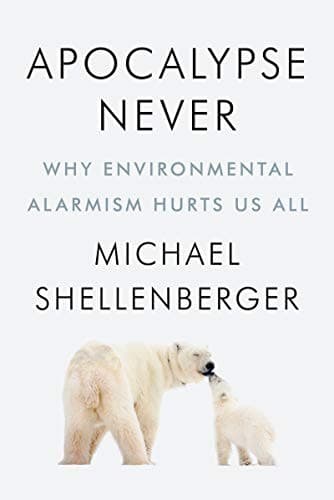
Core Idea
- Apocalypse Never argues that environmental problems are real but usually manageable, and that alarmism often obscures practical solutions while pushing anti-human, anti-development politics.
- Shellenberger’s core claim is that industrialization, energy abundance, urbanization, and technological substitution have repeatedly reduced harm to people and nature, even when activists present them as environmental threats.
- He treats much modern climate and conservation rhetoric as a mix of exaggerated science, misleading imagery, and elite moral psychology that can produce fear, resentment, and bad policy.
The Author’s Central Critique of Environmental Alarmism
- The book opens with Extinction Rebellion protests as a case study in apocalyptic messaging, noting claims that “billions” will die and “life on Earth is dying” alongside disruptive tactics that seemed hard to justify if civilization were truly near collapse.
- Shellenberger argues that media, activists, and public figures often go beyond what the IPCC actually says, turning serious risks into civilization-ending narratives.
- He emphasizes that climate change is not human extinction, citing scientists who reject “apocalypse criers” and noting that disaster death rates and economic damage from extreme weather have fallen sharply over decades.
- Sea-level rise, in his telling, is gradual and adaptive rather than instantly catastrophic, with examples like the Netherlands used to show that people can live below sea level with engineering and planning.
- He repeatedly argues that environmental alarmism confuses real harm with imminent collapse, and that this confusion drives worse politics and less effective solutions.
Growth, Development, and Why Richer Societies Damage Nature Less
- A major theme is that development usually protects nature by shifting people away from land-intensive subsistence and toward cities, factories, and higher-yield agriculture.
- He uses Indonesia and the story of Suparti, a rural woman who found factory work, to show manufacturing as a path to wages, autonomy, urban life, and lower dependence on farming.
- The book argues that cities occupy a tiny share of Earth’s surface, while industrial production lets fewer farmers feed more people; agriculture rose only modestly in land use since 1961 while food output surged far more.
- Mechanization, fertilizer, irrigation, and machinery are presented as the real engines of land sparing, including the claim that U.S. tractorization freed land on the scale of California.
- Shellenberger contends that wealth improves infrastructure, sanitation, flood control, and waste systems, which in turn reduces environmental leakage and human vulnerability.
- He also argues that wealth is associated with lower poverty, longer life expectancy, lower infant mortality, and greater freedom for women and minorities.
Substitution, Energy Density, and Why He Defends Fossil Fuels
- The book’s recurring logic is that substitutes beat scarcity, and that environmental gains often come from replacing older, more damaging materials and fuels with denser, cleaner ones.
- He cites the replacement of whale oil by petroleum and vegetable oils as a case where markets and innovation mattered more than moral campaigns.
- He argues that energy density matters: wood is land-hungry and burdensome, while coal, gas, and oil deliver far more power with far less land and labor.
- Natural gas is presented as cleaner than coal on most measures, and fracking is defended as a major reason U.S. emissions fell while coal mining declined.
- The author also claims that elite opposition to coal, gas, and nuclear often comes from affluent activists, not from poor people who need cheap energy most.
- For poor countries, he argues, industrialization and energy access matter more than early decarbonization; he even suggests that faster coal use in places like India could lower future emissions by enabling development and lower fertility.
Why He Rejects 100% Renewables
- Shellenberger treats solar and wind as too dilute and intermittent to power modern civilization without vast land use, storage, backup, and grid expansion.
- He says solar-plus-battery systems are expensive and fragile, and uses examples like Uganda and Australia to show storage limits in real-world conditions.
- He criticizes “100% renewable” models for relying on unrealistic assumptions about batteries, hydrogen, hydro storage, and grid balancing.
- Germany’s Energiewende is used as the cautionary example: huge spending, higher electricity prices, and continued dependence on backup power.
- Wind is portrayed as especially problematic because of land footprint and wildlife impacts, including bats, eagles, cranes, and other birds.
- Solar farms are criticized for their ecological footprint, material intensity, and waste issues, including toxic disposal and e-waste exported to poorer countries.
- Biofuels are portrayed as land-intensive and often worse than fossil fuels once land-use change is counted.
Conservation, Wildlife, and the Politics of “Natural”
- The book argues that many conservation crises are really about poverty, insecurity, and development, not climate apocalypse.
- He rejects “sixth extinction” rhetoric as overstated, saying real extinction rates are much lower than popular alarm suggests, though many species remain threatened by habitat loss and human pressure.
- Protected-area conservation is criticized when it excludes local people, creates resentment, or reproduces colonial patterns of displacement.
- The Amazon chapter argues that deforestation is real but that activist messaging often misstates facts, including claims about the rainforest’s oxygen production and climate role.
- Plastic waste is presented as a serious issue, but one best addressed through waste systems and infrastructure rather than symbolic targets like straws.
- He repeatedly attacks the appeal-to-nature fallacy: natural is not automatically better, and many “artificial” goods reduce pressure on wildlife, forests, and land.
Climate Politics, Psychology, and “Environmental Humanism”
- In the book’s final arc, Shellenberger argues that environmentalism functions as a kind of secular religion for educated elites, providing moral clarity, identity, and meaning through apocalyptic struggle.
- He uses Ernest Becker’s ideas about death-denial and “immortality projects” to explain why some activists are drawn to catastrophe narratives.
- He says alarmism contributes to climate anxiety, especially among young people, and that even he was once emotionally drawn to apocalyptic environmentalism.
- His alternative is environmental humanism: keep science and religion distinct, but affirm human specialness, prosperity, and environmental progress together.
- The book closes by insisting that people want both nature and prosperity, and that the best conservation outcomes usually depend on energy access, industrialization, and development rather than fear-driven restriction.
What To Take Away
- Alarmism is the book’s main target: Shellenberger thinks it distorts science, politics, and public psychology more than it motivates useful action.
- His preferred pattern is substitution plus growth: denser fuels, better machines, higher yields, and richer societies tend to reduce pressure on land and wildlife.
- He is consistently development-first: for poor countries, electricity, factories, and infrastructure are framed as prerequisites for both human welfare and conservation.
- The book’s bottom line is that environmentalism should stop treating modernity as the enemy and start treating human flourishing as part of the solution.
Generated with GPT-5.4 Mini · prompt 2026-05-11-v6