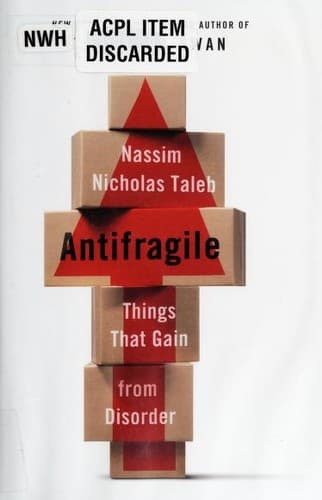
Core Idea
- Antifragility is Taleb’s name for things that benefit from volatility, shocks, randomness, stress, and disorder, unlike fragile things that are harmed and robust things that merely resist damage.
- The book’s central claim is that many real systems—biological, social, economic, cultural, and even informational—are best understood by their asymmetry: whether random change gives them more upside than downside.
- Taleb argues that modern institutions often fragilize systems by suppressing variation, hiding risk, and overintervening in complex environments they do not understand.
Main Concepts and Mechanisms
- The core test is simple: if an entity has more to gain than lose from randomness, it is antifragile; if it has more to lose than gain, it is fragile.
- Robustness is not enough, because robust systems survive shocks but do not improve from them; antifragile systems regenerate, overcompensate, and get stronger.
- Taleb’s recurring “extended disorder family” includes uncertainty, volatility, entropy, randomness, error, time, stressors, and chaos.
- He uses mythic triads to clarify the spectrum: Damocles for fragility, Phoenix for recovery, and Hydra for true antifragility because it regrows after injury.
- Many living systems exhibit hormesis or Mithridatization: small doses of harm can improve resilience, but the stronger principle is that populations and genes can gain from turnover and selective failure.
- Redundancy looks wasteful until shocks arrive; extra capacity, spare organs, buffers, and stockpiles are part of how antifragile systems absorb disorder.
- Antifragility depends on optional exposure: keep downside small and limited while leaving upside open-ended.
- This logic is formalized through convexity: in nonlinear systems, the payoff from volatility can be positive even when the average outcome looks unchanged.
- Taleb repeatedly warns against the average fallacy: in fragile systems, the dispersion of outcomes matters more than the mean.
How Taleb Applies the Idea
- In biology, bones strengthen under episodic load, exercise can overshoot into improvement, and aging is partly a failure to adapt to the right pattern of stress and recovery.
- In evolution, individual organisms may die, but the gene pool improves through mutation, selection, and turnover; nature “fights the next war,” not the last one.
- In politics and markets, too much stability can create hidden buildup and catastrophic blowups; a little randomness or turnover can act like annealing, preventing dangerous rigidity.
- Taleb uses the steam-engine governor, market calm before crashes, and Buridan’s donkey to show that small randomness can stabilize systems that otherwise lock up or overreact.
- He argues that stressors are information in complex systems, where cause and effect are opaque and linear control often backfires.
- His critique of modernity is that it replaces organic, bottom-up adaptation with top-down planning, efficiency, and overconfidence in prediction.
- He calls people who overestimate formal knowledge and intervene in complex systems fragilistas.
- Medicine is his major example of iatrogenics: well-meant intervention often causes harm, especially when doctors or institutions optimize for action rather than net benefit.
- He extends iatrogenics beyond medicine to economics, education, regulation, and politics, where “doing something” can be worse than leaving systems alone.
- The book consistently prefers simple heuristics over elaborate models when the system is too complex and the cost of error is asymmetric.
Skin in the Game, Optionality, and Barbell Thinking
- Taleb’s ethics are built around skin in the game: no one should gain upside from volatility while shifting downside to others.
- He thinks modern institutions are riddled with hidden asymmetries, from corporate stock options to leveraged finance to policy making, where losses are socialized and gains privatized.
- The practical structure he favors is the barbell: put most exposure in very safe, low-risk form and a small part in high-upside, high-risk bets.
- The barbell works because it clips ruin while preserving exposure to positive Black Swans.
- He also values optionality: small, limited-loss positions that grant the right, but not the obligation, to benefit from favorable uncertainty.
- Thales is his emblematic example of option-like thinking, and he contrasts this with the false belief that success always comes from superior prediction.
- Optionality reduces the need for precise knowledge because one need only recognize and keep favorable outcomes, not forecast them exactly.
- This leads to a broader moral claim: your freedom and security should not be built by making others more fragile.
What To Take Away
- Taleb’s big insight is not “embrace risk,” but design for asymmetry: avoid ruin, keep upside, and let randomness work in your favor.
- In complex systems, the safest-looking route is often the most dangerous, because suppressing small stressors can create larger hidden fragility.
- The book’s practical lens is to ask of any person, policy, or system: who gets the upside, who bears the downside, and what happens under volatility?
- Antifragility is ultimately a prescription for fewer naive interventions, more optionality, more humility about prediction, and stricter ethics about transferring harm to others.
Generated with GPT-5.4 Mini · prompt 2026-05-11-v6