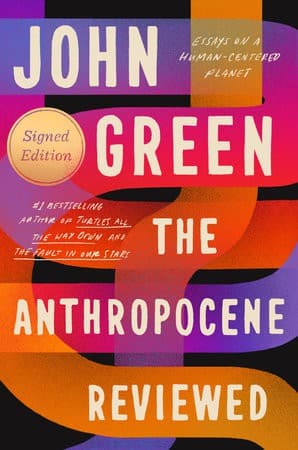
Core Idea
- Green treats the Anthropocene as a condition of total participation: there are no detached observers, only human beings embedded in and altering a shared world.
- The book uses short, scored reviews of ordinary things—songs, objects, places, games, disasters—to show that attention is a moral act and that memoir can hide inside criticism.
- Its deepest tension is that humans are both wondrous and destructive: capable of love, art, and solidarity, yet also responsible for climate change, extinction, inequality, and myth-making.
How the Reviews Work
- Green’s review form, borrowed from Booklist, is intentionally constrained, letting him praise and criticize in a compact space without pretending to total objectivity.
- He rejects neat metaphors of illness and instead insists that pain, disease, and grief should be taken as real experiences rather than cosmic lessons.
- Many essays begin from a personal memory, then widen into history, ecology, technology, or culture, so that the “review” becomes a way of tracing how the self is entangled with the world.
- The five-star scale is used less as a verdict than as a prompt for attention; even low-scored subjects can reveal beauty, harm, or both.
Human Power, Human Damage
- Green repeatedly returns to the fact that humans reshape systems far larger than ourselves: landscapes, climate, news, consumer habits, sports, and even the stories we tell about nature.
- Climate change is treated as a real apocalypse for many species, but not as the end of the planet; Green leans on Hank Green’s refrain that “the species will survive this” as a reason to keep acting.
- Essays on air-conditioning, lawns, Piggly Wiggly, Monopoly, and CNN show how convenience, capitalism, and media systems produce hidden costs: fossil-fuel dependence, ecological waste, labor loss, and context-starved understanding.
- He is especially alert to systems that look neutral but are not: office temperatures built around men in suits, news that prizes what is new over what is important, and games that naturalize inequality.
- In stories about Canada geese, teddy bears, velociraptors, and the Hall of Presidents, Green shows how humans domesticate, distort, sentimentalize, or weaponize the nonhuman world and then mistake the result for nature or history.
Wonder, Memory, and Solidarity
- Green’s best essays insist that wonder is not rarefied; it comes from ordinary attention, whether to a brown oak leaf, a sunset, a comet’s return, or a photograph’s changing meaning over time.
- He argues that beauty depends as much on how we look as on what is there, and that science can explain phenomena like sunsets without canceling their power.
- Memory is repeatedly shown to be sensory and unstable: scratch ’n’ sniff stickers, Diet Dr Pepper, whispering, and songs all trigger involuntary returns to earlier selves.
- Music receives special emphasis because it can carry grief and endurance at once, as in “You’ll Never Walk Alone,” “Auld Lang Syne,” and “New Partner.”
- The book’s emotional center is not optimism but companionship: being with other people in suffering, in worship, in hospitals, in war, or in sports can make endurance possible.
- Green finds models of solidarity in things as different as Liverpool fans singing, the Christmas Truce, a family apartment during the Iraq War, and a paramedic chorus in an ICU.
What To Take Away
- Green’s core claim is that paying attention is both the book’s method and its ethic: to notice the world honestly is already to participate in it.
- Human beings cannot escape complicity, but they can choose whether they respond with denial, irony, or care.
- The book refuses false comfort: it acknowledges illness, racism, extinction, and grief without pretending these are redeemed by metaphor.
- At the same time, it insists that beauty, humor, art, and shared rituals are real forms of courage in a damaged but still lovable world.
Generated with GPT-5.4 Mini · prompt 2026-05-11-v6