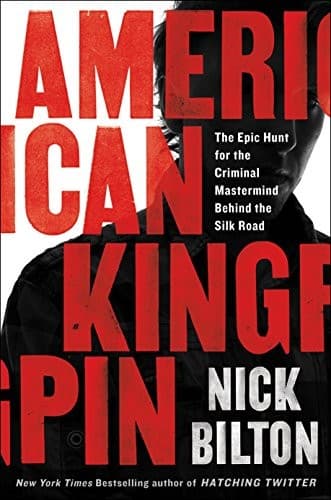
Core Idea
- American Kingpin tells the parallel rise-and-fall of Ross Ulbricht, the libertarian idealist who built Silk Road, and the investigators who slowly figured out how to catch him.
- The book’s central tension is that Silk Road was both a technical breakthrough in anonymity and a criminal marketplace that normalized anonymous access to drugs, weapons, and eventually murder-for-hire.
- Bilton frames the case as a collision between ideology, technology, and law enforcement improvisation: Ross believed he was building a freer world, while agents learned to hunt a digital kingpin using old-school pattern recognition, undercover work, and patient forensic reconstruction.
Ross Ulbricht and the Making of Silk Road
- Ross is presented as brilliant, self-disciplined, and intensely libertarian, with a deep belief that the government should not control what people do with their bodies or lives.
- His early experiments with austerity, seasteading, and failed startups give way to the idea for an anonymous marketplace, with Tor providing anonymity and Bitcoin providing payment.
- He builds Silk Road almost entirely himself, names it after the ancient trade route, and launches it with his own mushroom listings, marketing it anonymously through forums under Altoid.
- The site explodes after a Gawker story publicly reveals it as the place where you can buy “any drug imaginable,” which draws mainstream attention, Senate outrage, and far more users.
- Ross sees himself as a captain and eventually as a founder of a world-changing system, but the same growth creates operational failures, bugs, and a widening gap between his libertarian theory and the violence his marketplace enables.
- What begins with psychedelics expands to heroin, cocaine, guns, silencers, and other contraband, and Ross repeatedly rationalizes the expansion as a matter of individual freedom and constitutional liberty.
- His relationship with Julia repeatedly exposes the moral cost of the project: she becomes alarmed as the site grows more dangerous, and Ross’s secrecy, compartmentalization, and emotional split between “Ross” and DPR drive them apart.
The Investigation: Pattern-Spotting, Undercover Work, and Turf Wars
- Jared Der-Yeghiayan notices Silk Road through a seized pink ecstasy pill and refuses to treat it as a trivial customs case, instead seeing the possibility of a much larger criminal infrastructure.
- His method is obsessive and physical as much as digital: he collects seized envelopes, studies packaging, compares listings and photos, and builds a warehouse-like archive to connect shipments to vendors.
- The investigation is complicated by agency turf battles, especially between Chicago HSI, Baltimore, the DEA, and later the FBI, each trying to control pieces of the case.
- Carl Force, a jaded DEA agent, goes undercover as Nob and then Kevin, inventing elaborate personas and using them to exploit the site and siphon money from Ross.
- The book repeatedly shows that online investigations still depend on credibility, backstory, and operational discipline; investigators cannot just “show up” on the internet without becoming characters.
- Jared and others study DPR’s writing for linguistic tells, while Gary Alford, using a more analog clue-hunting mentality, eventually finds the crucial “Altoid” post and connects it to Ross Ulbricht’s email.
- The FBI’s biggest breakthrough comes from getting the server data and catching Ross with his laptop open, because Tarbell understands from prior cases that closing the computer can destroy the evidence.
- Ross is arrested with the Mastermind page open, charged under multiple counts including the Kingpin Statute, and later receives a life sentence plus additional years.
Collapse, Aftermath, and the Book’s Larger Implications
- Ross’s downfall is not just the result of one clue but of accumulating pressure: extortion, hacking, server exposure, undercover infiltration, interagency coordination, and his own growing need for secrecy.
- He authorizes escalating violence, including murder-for-hire, which turns Silk Road from a provocative libertarian experiment into a true criminal enterprise with irreversible moral consequences.
- The book gives substantial attention to the people around the case, including Variety Jones as Ross’s most important mentor, advisor, and co-conspirator, and later one of the last fugitives captured.
- After Ross’s arrest, the investigation continues into employee theft, fake personas, stolen Bitcoin, and side schemes, showing how the Silk Road ecosystem generated opportunism at every level.
- The story ends by stressing that shutting down Silk Road did not end the market it revealed: successor sites appeared quickly, online drug buying expanded, and the broader opioid crisis continued to worsen.
- Bilton uses this to underline a grim irony: Ross did help make drug buying easier and sometimes safer than street dealing, but that same accessibility also sat inside a much larger wave of addiction, overdose, and harm.
What To Take Away
- Silk Road was not just a website but a proof that anonymous tools could scale criminal commerce faster than institutions could respond.
- Ross Ulbricht’s downfall came from the mismatch between his idealistic self-image and the practical violence required to keep the marketplace running.
- The case shows that digital manhunts still depend on mundane clues, patience, and human error more than on flashy cyber wizardry.
- Bilton’s final picture is unsettling: the market Ross created was shut down, but the behavior it normalized proved durable.
Generated with GPT-5.4 Mini · prompt 2026-05-11-v6