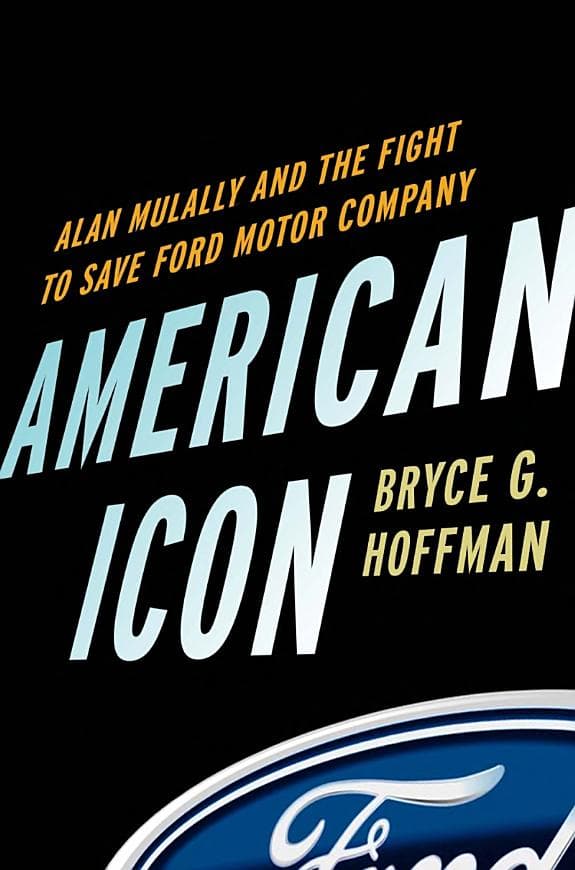
Core Idea
- Bryce G. Hoffman treats Ford’s near-collapse and recovery as a long-running struggle between a powerful brand and a culture that repeatedly sabotaged itself through overexpansion, secrecy, infighting, and complacency.
- The book argues that Ford was not saved by a single product or lucky bailout, but by Alan Mulally’s outsider leadership, which forced the company to face reality, work as one team, and align capital, organization, and products around a coherent plan.
- Ford’s turnaround mattered because it was, in Hoffman’s telling, an American industrial icon trying to survive the collapse of old Detroit assumptions without losing family control or becoming GM/Chrysler’s bailout case.
How Ford Got Broken
- Hoffman traces Ford’s crisis back to an old pattern: the company repeatedly hit success with one breakthrough product, then underinvested in the next one.
- Henry Ford built the modern mass-production company with the Model T, the moving assembly line, and the $5-a-day wage, but his anti-institutional management style also drove away talent and made Ford resistant to change.
- The company’s culture of fear and intrigue deepened under Harry Bennett, whose Ford Service Department enforced loyalty through intimidation.
- Henry Ford II modernized the company with the Whiz Kids, but the later imperial style of Ford leadership encouraged politics, turf wars, and internal maneuvering.
- In the 1970s and 1980s, Ford was battered by regulation, fuel shocks, Japanese competition, quality problems, and costly litigation, then recovered with the Taurus, labor concessions, and downsizing.
- The 1990s SUV boom temporarily masked weakness, but Ford’s profit engine depended heavily on trucks like the Explorer, Expedition, and Excursion, which also worsened fuel-economy and brand perception.
- Under Jac Nasser, Ford pursued a “house of brands” strategy that spread the company into noncore ventures, luxury acquisitions, and dot-com style expansion while morale collapsed.
- The Firestone tire crisis on Explorers badly damaged Ford’s reputation and showed how fragile the company’s product and quality systems had become.
- By the time Bill Ford took over, Ford had a North American business that was structurally uncompetitive, a fragmented global organization, and a board increasingly forced to consider drastic options.
Bill Ford, the Family, and the Financing Gamble
- Bill Ford Jr. is portrayed as a reluctant heir: environmentally minded, less conventional than a Detroit CEO, and deeply concerned that the Ford name itself was being damaged.
- He cut costs, closed factories, reduced dividends, and pushed a “Back to Basics” reset, but the company still lacked a compelling leadership structure and a true product strategy.
- The failed searches for a CEO underscored Bill Ford’s limited willingness to hand over real power until he found Mulally.
- Alan Mulally arrives from Boeing with a reputation for turnaround work, operational discipline, and a belief that “you can’t manage a secret.”
- His recruitment is tied to a massive financing plan: Ford had to mortgage nearly everything, including domestic assets and Ford Credit, to raise enough cash to survive.
- The family’s Class B shares protected control but also constrained strategic flexibility; Hoffman presents this as a stabilizing force that prevented a sale or Chapter 11, even as critics called it undemocratic.
- The bank deal, ultimately worth $23.6 billion, gave Mulally the runway he needed to restructure without a bailout.
Mulally’s System: Truth, One Team, One Ford
- Mulally’s first move was cultural and procedural: replace politics with a weekly Business Plan Review (BPR) and follow-on Special Attention Review (SAR).
- The BPR required a single, color-coded dashboard where executives had to show reality, not spin; green, yellow, and red statuses made problems visible.
- His rule set emphasized people, facts, one plan, transparency, and “find-a-way” behavior, and his repeated demand was simple: “Trust the process.”
- The breakthrough came when executives finally admitted red and yellow items instead of hiding them; Hoffman treats that moment as the turning point in Ford’s internal honesty.
- Mulally also changed behavior informally by eating in the cafeteria, answering emails personally, and walking the halls to flatten hierarchy and reduce insulation.
- He reorganized Ford into a global matrix with four business units—Asia Pacific, Europe, the Americas, and Ford Credit—plus functional leaders who reported across regions.
- He pared back Ford’s brand sprawl, pushing the company toward One Ford and eventually selling or killing nonessential brands such as Aston Martin, Jaguar, Land Rover, Volvo, and Mercury.
- The old culture of regional fiefdoms and executive privilege was weakened as Mulally removed or sidelined resistant figures and elevated people willing to work within the system.
- Key allies included Don Leclair at finance, Bennie Fowler on quality, Derrick Kuzak in product development, Tony Brown in purchasing, and later Jim Farley in marketing.
Products, Crisis, and the Recovery
- Mulally’s strategy was not just cost-cutting; it was to rebuild Ford around better products, especially globally shared platforms and disciplined development processes.
- The Global Product Development System (GPDS) integrated design, engineering, purchasing, and manufacturing earlier, reducing rework and making Ford’s product pipeline more coherent.
- Ford’s early showcases included Sync with Microsoft, which became a symbol of the company’s new willingness to combine technology and mainstream cars.
- As the 2008 financial crisis hit, Ford’s truck business collapsed, credit tightened, and Mulally shifted from turnaround to survival mode without abandoning product investment.
- Ford used supplier support programs like Project Quark to keep the supply base alive, because supplier collapse could have crippled the company and the wider industry.
- Unlike GM and Chrysler, Ford refused a bailout, instead relying on its financing cushion, UAW concessions, debt swaps, and relentless liquidity management.
- The company’s UAW deal, VEBA restructuring, and debt exchange materially strengthened the balance sheet and became part of the reason Ford could emerge without government rescue.
- The payoff came in product launches such as the global Focus, the improved Taurus, Fusion Hybrid, EcoBoost, and other vehicles built on shared architecture and tighter discipline.
- By 2010 Ford had restored investment-grade credit, reduced debt sharply, and become highly profitable while still expanding in China, India, and other regions.
What To Take Away
- Ford’s rescue was less about charisma than about organizational clarity, brutal honesty, and disciplined execution.
- Hoffman’s central claim is that Mulally succeeded because he made the company tell the truth to itself and then built a system that could act on that truth.
- The book also argues that Ford’s family control was not a quaint relic but a decisive factor that preserved independence long enough for the turnaround to work.
- The larger lesson is that corporate survival depends on products, structure, cash, and culture together; fixing only one of them would not have saved Ford.
Generated with GPT-5.4 Mini · prompt 2026-05-11-v6