Core Idea
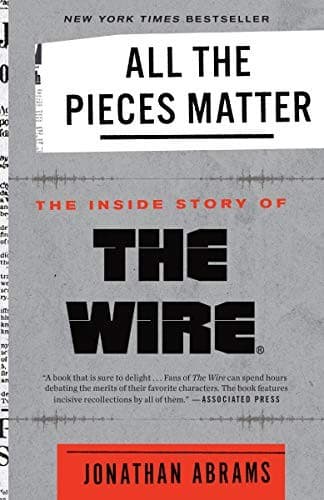
- All the Pieces Matter is an oral history of The Wire that treats the show as a deliberately realistic, institution-centered novel about Baltimore, not a conventional cop drama.
- David Simon and Ed Burns built the series from lived experience in policing, journalism, teaching, and the drug war, and the book shows how that realism shaped every major creative choice.
- The show’s core argument is that institutions overpower individuals, reform is hard and usually partial, and American systems of policing, education, politics, labor, and media are intertwined.
How The Wire Was Made
- Simon pitched the show as an “argument of dissent”: instead of asking whether bad guys get caught, it asks who the bad guys are, what systems produce them, and whether catching them matters.
- Casting was central to authenticity, with Alexa Fogel and Pat Moran favoring the right eyes, local specificity, and hard-earned chemistry over star power.
- Many roles came from a mix of Simon-world veterans and surprising newcomers, including Dominic West, Idris Elba, Michael B. Jordan, Andre Royo, and Michael K. Williams.
- Simon often avoided having actors meet their real-life inspirations so they would not imitate a biography instead of playing what was on the page.
- The production’s realism extended to location shooting, rough neighborhoods, actual danger, wiretap audio that was imperfect but intelligible, and a largely unsweetened soundscape with Tom Waits’s “Way Down in the Hole” as the theme.
- The show’s visual style matured from handheld grit to more deliberate composition, and the production treated Baltimore locations as living parts of the story, not backdrops.
- Key creative figures included Robert Colesberry, who shaped the show’s visual language and collaborative tone, and George Pelecanos, Richard Price, Dennis Lehane, and Bill Zorzi, who strengthened the writers’ room with novelist-like attention to character and city.
What the Show Is Saying
- The book repeatedly stresses that The Wire is less about plot payoff than about institutional logic: police, schools, politics, ports, unions, and street economies all reproduce dysfunction.
- Season 1 grows out of Simon’s reporting on the Melvin Williams wiretap, but the story quickly expands into a larger meditation on the drug war, political pressure, and bureaucratic failure.
- Season 2 widens the lens to labor and deindustrialization, insisting that the crisis is about class as much as race; Simon and Burns argued that the white dockworkers belong in the same social story.
- Season 3 centers city politics through Carcetti, Royce, Burrell, and Clay Davis, showing reformers, power brokers, and hustlers as constrained by ambition, inertia, and institutional incentives.
- Season 4 is the sharpest statement of the show’s thesis about children: kids don’t vote, and schools, families, and neighborhoods fail long before the corner does.
- Burns’s own teaching experience and his belief that intervention must start at ages zero to three inform the season’s bleak view of educational opportunity.
- Season 4’s four boys—Michael, Namond, Dukie, and Randy—embody different fates produced by the same broken system, with only one partial escape.
- The book emphasizes that the show’s emotional force comes from contradiction: Wallace’s murder, Bodie’s death, Omar’s code, Kima’s survival, and Bubbles’s pain all refuse clean moral categories.
- Omar is presented as a composite of real stick-up men and informants, and his impact comes from making the show’s world morally legible without making it simple.
- The series also mattered because it portrayed Black characters as fully dimensional, not as isolated “the Black guy” types, and because it treated gay characters and Black queer life as part of the world rather than a side issue.
The Show’s Reach, Reception, and Afterlife
- The Wire struggled in real time: it was slow, complex, often ignored by awards voters, and initially watched by too few people for the cast and crew to feel secure.
- HBO executives and reviewers often admired it but worried about its refusal to deliver standard cop-show closure.
- Its reputation grew later through DVDs, On Demand, screeners, universities, and word of mouth, eventually turning it into a prestige marker for viewers who “got it.”
- Baltimore itself became inseparable from the show, though the relationship was tense: some local officials and police saw it as a smear that hurt tourism and reinforced hopelessness.
- The book notes that the series did real material work in Baltimore through hiring, location spending, and later charitable efforts such as coat drives, food drives, and the Ella Thompson Fund.
- Freddie Gray’s death and the 2015 unrest made the show feel prophetic to many observers, though Simon resists claiming foresight beyond what the series already showed about routine police abuse and van rides.
- Obama’s praise of the show, including naming Omar his favorite character, is treated as a symbolic high point that validated its social seriousness.
- The oral history also records the personal costs: typecasting, burnout, depression, addiction struggles, and the sense among many cast members that the show changed their lives as much as their careers.
What To Take Away
- The Wire endures because it made a large argument about America through one city, one set of institutions, and one stubbornly realistic storytelling method.
- Its greatness comes from accumulation: every detail, line, and casting choice is meant to make the system feel lived-in and inescapable.
- The show’s deepest claim is not that reform is impossible, but that individual rescue is easier than institutional repair.
- Abrams’s book preserves the fact that the series was a hard, collaborative, often uncertain achievement whose influence grew only after its own moment had passed.
Generated with GPT-5.4 Mini · prompt 2026-05-11-v6