Core Idea
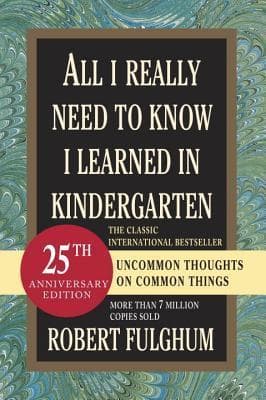
- Fulghum argues that the deepest rules for civilized life are elemental: share, play fair, don’t hurt people, clean up your mess, tell the truth, and hold hands and stick together.
- He treats “kindergarten” not as childishness but as the distillation of civilization—the first, clearest version of the ethics adults keep relearning in harder forms.
- The book’s stake is simple but serious: adulthood tests whether people can keep practicing those basics under pressure, complexity, disappointment, and loss.
Kindergarten as Adult Wisdom
- In “Deep Kindergarten,” Fulghum recasts classroom rules as compressed social truths: share everything, play fair, don’t hit people, clean up your own mess, don’t take what isn’t yours, say you’re sorry, flush, wash your hands, take naps, and look.
- Each rule points beyond childhood manners to a larger adult field: fairness in resource sharing, nonviolence, environmental responsibility, public health, attention, and curiosity.
- He insists that knowing the rules is not enough; the human race keeps relearning that we are what we do, not just what we think.
- The kindergarten lesson also contains two overlooked truths: life is brief, and no one gets through it alone, which is why the old guidance ends with going out into the world holding hands and sticking together.
Stories, Perspective, and Ordinary Goodness
- The essays work through anecdote, using children, neighbors, workers, and strangers to show how the rules reappear in ordinary life.
- Puddles becomes a test of joy and flexibility, where the child’s urge to jump in the water exposes how often adults outgrow delight before they outgrow fear.
- Spiders shifts perspective between human panic and the spider whose web has been destroyed, turning the spider song into a parable of setback, survival, and climbing again.
- The Rest of the Story argues that children are right to want what happens after the ending, because life always continues into consequence.
- In Hide and Seek, being found becomes a metaphor for vulnerability and community, with “Olly-olly-oxen-free” standing for the need to be gathered back in.
- Angels presents Eli Angel the shoemaker as a model of hidden holiness: true goodness is measured by mitzvot, small good deeds without expectation of reward.
- Essays such as Help, Bar Story, and Third Aid treat receiving help, asking for help, and practical self-care as moral disciplines, not merely technical skills.
- Gummy Lump, Crayolas, and the Christmas pieces present memory, play, and ritual as serious forms of love, where children’s handmade gifts and inventions can matter more than adult polish.
- Neighborhood essays about the guy next door, dandelions, snow, hair, and stick-polishing show that domestic life is a field for ethics, patience, and mutual influence.
- Family-centered pieces like Grandfather, Mary’s Dad, and Moths suggest that family stories are partly remembered, partly invented, and partly wished into being.
- Fulghum treats imagination not as escape but as a way people shape identity across generations and sustain meaning in daily life.
- Mother Teresa and Pass It On widen the frame, linking small acts of compassion in private life to public morality and political life.
Limits, Truth, and Revision
- Fulghum is unusually open about revising his own stories, sometimes correcting or expanding them and admitting that some pieces were simplified, combined, or altered for Truth rather than strict literal fact.
- The Larry Walters essays show this tension clearly: the first version celebrates imagination and flight, while the later correction adds altitude, FAA penalties, and Walters’s suicide without erasing the original admiration.
- This openness reflects the book’s central tension between naïveté and experience: Fulghum values wonder, but he refuses to pretend that life is always fair, happy, or tidy.
- The book’s answer to mortality, disappointment, and disorder is not cynicism or denial, but practice—do the small good, tell the truth, and stay connected.
What To Take Away
- Kindergarten rules are adult rules: share, apologize, clean up, look closely, and don’t hurt people because civilization depends on them.
- Perspective changes meaning: puddles, spiders, neighborhoods, and family rituals reveal more when seen from another angle.
- Imagination and memory matter morally: they help people give, grieve, celebrate, and make sense of ordinary life.
- Fulghum’s enduring test is whether you can live what you already know: be fair, be kind, be truthful, and keep going together.
Generated with GPT-5.4 Mini · prompt 2026-05-11-v6