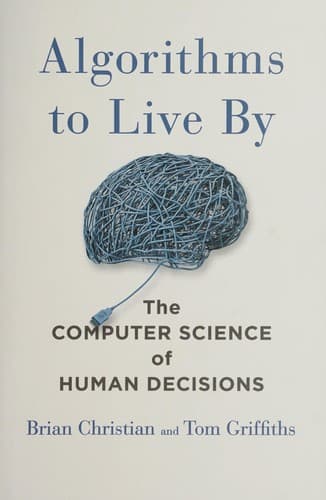
Core Idea
- The book argues that many everyday human problems are structurally the same as classic problems in computer science: deciding when to stop, when to explore, how to store and retrieve information, how to handle intractability, and how to coordinate with others under strategic conflict.
- Its core claim is not that life is literally a computer program, but that algorithms reveal the hidden constraints of real choice: limited time, limited attention, uncertainty, and tradeoffs among speed, accuracy, and effort.
- The authors treat “good rationality” as using the right procedure for the problem, even when the outcome is uncertain or disappointing.
Choosing Well Under Uncertainty
- Optimal stopping is the book’s opening lens: in serial choices like apartment hunting, dating, hiring, or parking, the hard part is knowing when to stop searching and commit.
- In the classic secretary problem, the 37% Rule says to spend about 37% of the search observing, then take the first option better than everything seen so far.
- The same structure shifts under different information regimes: with full information, the book replaces look-then-leap with a Threshold Rule based on the objective quality of the current option.
- Variants matter: if rejected offers can be revisited or if waiting has explicit costs, the optimal cutoff changes, but the basic principle remains that time itself is part of the problem.
- The parking example shows how occupancy rate changes the stopping threshold; Donald Shoup’s case for about 85% occupancy argues that near-full parking wastes more time than it saves space.
- The burglar example turns “quit while you’re ahead” into an expected-value calculation: keep going while reward outweighs the probability of losing accumulated gains.
- Experimental work suggests people often stop too early, but the book argues this can reflect endogenous time cost—search always has an opportunity cost, even when experiments pretend it does not.
Explore, Exploit, and Remember
- The explore/exploit tradeoff asks when to try something new versus use what is already known to work.
- The book’s central model is the multi-armed bandit: each option is uncertain, and the best choice depends on how much time remains.
- Seize the interval names the idea that exploration is most valuable when the time horizon is long enough for discoveries to pay off later.
- Win-Stay, Lose-Shift captures a simple heuristic, but the book emphasizes that “lose-shift” can be too eager to abandon good options after a single bad draw.
- John Gittins’s Gittins index is presented as the exact solution under geometric discounting: always pick the arm with the highest index, including a hidden exploration bonus for unknown options.
- Because exact bandit solutions can be hard to compute, the book turns to regret and to simpler algorithms such as Upper Confidence Bound (UCB), which chooses the option with the highest plausible payoff and embodies “optimism in the face of uncertainty.”
- The same logic appears in real systems like A/B testing, online advertising, and adaptive clinical trials, where learning and doing good by current patients are in tension.
- The book treats adaptive medical designs such as “play the winner” as bandit-style alternatives to fixed randomized trials, while noting the ethical and statistical controversy around them.
- Human development and aging are recast in these terms: childhood is an exploration phase, while older adults increasingly exploit emotionally meaningful relationships, consistent with Laura Carstensen’s time-perception findings.
Memory, Storage, and Hard Problems
- The caching chapter argues that memory is less about storage alone than about where to keep things so they can be found quickly.
- Cache design depends on eviction rules; Bélády’s Algorithm is the clairvoyant optimum, but practical systems rely on LRU because of temporal locality.
- Temporal locality means recently used items are likely to be used again soon, which is why LRU works well in computers, libraries, browsers, and even household organization.
- The book’s home analogies—keeping tools near where they are used, using a valet stand, or arranging files by recent access—extend caching into everyday life.
- Human memory is described as a search problem, not just a storage problem; Anderson and Schooler’s work suggests the world itself has a recency structure that memory is tuned to exploit.
- Older adults are framed by Ramscar as “becoming archives”: retrieval slows because there is more stored knowledge to search, not simply because memory has failed.
Intractability, Randomness, Networking, and Strategy
- The wedding seating problem introduces intractability: some search spaces are so large that perfect solutions are unreachable, so the right move is relaxation rather than brute force.
- Constraint relaxation, continuous relaxation, and Lagrangian relaxation show how to solve easier versions of a hard problem, use the relaxed answer as a bound, and then map it back toward reality.
- The book treats randomness as a serious algorithmic tool, not a fallback: sampling underlies Monte Carlo methods, probabilistic primality testing, Bloom filters, and randomized search.
- Simulated annealing and other random-restart methods help escape local maxima; the lesson is that occasional randomness can improve optimization when greediness gets trapped.
- Networking is organized around protocols, packet switching, acknowledgments, and exponential backoff; the point is that reliable communication depends on controlled delay, retries, and flow regulation rather than perfect certainty.
- Bufferbloat shows why raw throughput is not enough: too much buffering destroys latency, so time must be treated as a first-class design variable.
- Game theory then shifts from optimization to strategic interaction: Nash equilibrium can exist even when finding it is computationally hard, and the prisoner’s dilemma and tragedy of the commons show how individually rational behavior can produce bad collective outcomes.
- The remedy is mechanism design: change the rules so that the desirable action is the equilibrium; Vickrey auctions are the book’s cleanest example, because truthful bidding becomes dominant.
- The broader conclusion is that many social problems are computational as well as strategic, so systems should be designed to make the right choice easier, more stable, and more truthful.
What To Take Away
- The book’s deepest message is that rationality is often about choosing the right algorithm under constraint, not finding a perfect answer.
- Many “mistakes” are really symptoms of hard problems: limited information, irreversible time, large search spaces, and strategic opponents.
- When a problem is intractable, the productive move is usually to relax constraints, approximate, randomize, or redesign the mechanism rather than demand exact optimization.
- The ethical endnote is computational kindness: make problems easier for other people to solve, and judge yourself by the quality of the process as much as by the luck of the outcome.
Generated with GPT-5.4 Mini · prompt 2026-05-11-v6