Core Idea
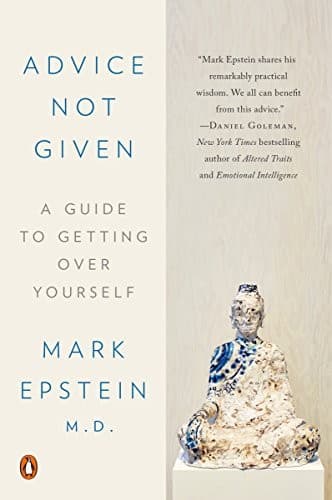
- Epstein’s central claim is that ego is the common source of suffering: people strain to become bigger, better, smarter, stronger, richer, or more attractive, and misery grows from that self-grasping.
- The book joins Buddhism and Western psychotherapy as two traditions that both strengthen an observing self without trying to erase the ego entirely.
- The point is not self-improvement as accomplishment, but learning when to talk back to the ego and when to surrender to what is actually happening.
Mindfulness, Therapy, and the Limits of Ego
- Epstein defines “Right” in the Eightfold Path as balanced, fitting, realistic, or attuned, not morally perfect.
- Right View begins with impermanence: meditation is a way to face change, loss, aging, illness, and death rather than to manufacture comfort.
- In concentration meditation one returns attention to a single object, while in mindfulness one notices thoughts, sensations, and the changing stream of experience.
- Buddhism and psychoanalysis converge in their emphasis on noticing rather than obeying mental contents; Freud’s free association and dream work parallel mindfulness in this respect.
- Epstein repeatedly warns against turning meditation into another ego project, such as becoming calmer, happier, or more successful.
- He tells the story of a Nepalese hermit whom the Dalai Lama sent back into life with the blunt instruction: “Get a life.”
- His point is that one should not use practice to escape ordinary responsibilities; one should make life into a meditation, not use meditation to flee life.
- Epstein’s own therapy showed him the value of psychoanalysis where meditation alone was insufficient, as in his sleep trouble, dream imagery, and buried oral rage after marriage.
- A failed teaching episode at the New York Open Center taught him that Buddhist instruction can be distorted by insecurity and abandonment fears; professional roles do not exempt anyone from personal patterns.
- He uses Winnicott’s idea of the good enough mother and holding environment to argue that emotions must be tolerated and held until they become intelligible.
- The meditative mind, like a good-enough parent, can hold tenderness, humor, anger, self-pity, and love without collapse.
- Primitive emotions are not contaminants to eliminate but fuel for growth when they are recognized and contained.
The Eightfold Path as Psychological Practice
- Right Motivation means not being ruled by unconscious impulses; conscious intention can rise above conditioning when one sees one’s patterns honestly.
- Right Speech includes inner speech: Epstein’s recurring warning is that just because you think it, doesn’t make it true.
- Sharon Salzberg’s healing is his model here, as therapy helped her question the self-story that she was undeserving and find a voice after childhood losses and silence.
- Epstein treats mourning as non-linear and non-technical; grief does not obey a timetable or the simplified “five stages” version of recovery.
- Right Action is restraint in service of life, not passivity or rigid rule-following.
- He uses figures like Samuel Beckett and the Zen tale of Bodhidharma and Huike to show that action can mean letting experience unfold rather than forcing a cure.
- Letting go is not suppression but a “backward step” into direct contact with experience, where what needs to drop away can do so on its own.
- In the case of Ralph, intrusive sexual and violent thoughts eased when he was encouraged to soften his inhibition and relate to the thoughts as thoughts rather than as moral facts.
- Epstein also draws on Reich, flirtation, and literary images to suggest that openness and play can loosen compulsive self-consciousness.
Livelihood, Effort, and the Ethics of Everyday Life
- Right Livelihood concerns more than earning a living: it asks what kind of mind one is cultivating through work, money, and ambition.
- Classical prohibitions against trading in weapons, humans, animals, intoxicants, and poisons are updated by Epstein to include modern exploitative systems like subprime mortgages.
- The real issue is the ethical and psychological cost of profiting from harmful work, not merely whether a job is prestigious or legal.
- Epstein treats money as a legitimate therapeutic topic because it so often becomes a measure of self-worth, shame, and status.
- The Buddha’s eight worldly concerns—gain/loss, pleasure/pain, praise/blame, fame/disgrace—shape identity but remain impermanent.
- His stories of Gloria and Kate show how resentment, entitlement, and identification with one’s role can make livelihood spiritually corrosive.
- Gloria’s shift comes when she recognizes her own scarcity and starts to feel care for others rather than only self-justifying anger.
- Angulimala illustrates that livelihood can be transformed at the level of identity, not just behavior: the murderer becomes a monk when his whole self-concept is interrupted.
- Right Effort is about balance, modeled by the lute player Sona: effort must be neither too tight nor too loose.
- In practice this means avoiding both restlessness and lassitude, and helping patients name feelings without forcing premature solutions.
- Epstein applies this to Debby and Martha, where holding the feeling gently allowed grief, shame, and self-blame to loosen.
- The Buddhist divine states—kindness, compassion, sympathetic joy, equanimity—emerge when self-centered preoccupation quiets.
What To Take Away
- The book’s deepest move is to shift attention from changing life circumstances to changing one’s relationship to ego.
- Meditation and psychotherapy are presented as complementary because both train self-observation, but both can fail if they become tools of self-optimization.
- The Eightfold Path is treated as a lived psychological discipline, not a purity code: Right means what is balanced and true enough to free one from reactivity.
- Epstein’s recurring lesson is that suffering eases when one can see thoughts, roles, money, and identity as contingent—not as the final truth about who one is.
Generated with GPT-5.4 Mini · prompt 2026-05-11-v6