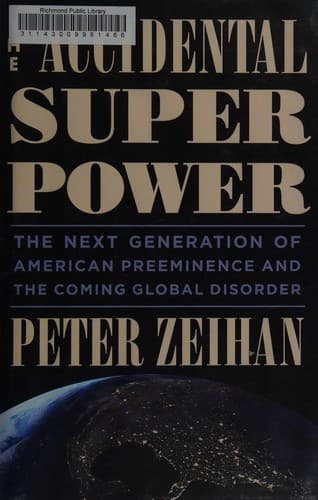
Core Idea
- Peter Zeihan argues that geography, not ideology, determines long-run national power, and that the United States became an “accidental superpower” because its terrain uniquely fits the technologies that matter in the modern era.
- The post-1944 order was built around Bretton Woods: the U.S. traded market access and maritime security for a stable world economy, but this system is temporary and will unravel as American priorities, demography, and energy independence change.
- The book’s larger warning is that the world is moving into a period of global disorder as the U.S. gradually stops subsidizing trade, aging societies lose capital and demand, and regional powers begin acting more aggressively.
Geography as Destiny
- Zeihan’s framework rests on three geographic advantages: balance of transport, deepwater navigation, and industrialization.
- Balance of transport means a state can move goods and people easily inside its borders while remaining hard to attack from outside; Egypt is his classic example, with the Nile serving as an internal artery protected by deserts.
- Egypt’s strength became stagnation: once unified, it faced little external pressure to innovate, and it was eventually breached by technologies that erased its natural buffers, such as the camel and cargo sailing.
- Deepwater navigation let states turn oceans into transport corridors; the compass, carvel shipbuilding, and gunports made Iberia, then England, the first great beneficiaries of global sea power.
- England’s North Sea environment forged a harsher maritime culture, and British naval power eventually displaced Iberian dominance and globalized trade and war.
- Industrialization multiplied output through steam, coal, chemistry, interchangeable parts, and machine tools, but its success depended on geography that could support dense transport and large-scale production.
- Germany industrialized quickly because its river junctions, rail-first organization, and centralized technical culture made it unusually efficient, though also strategically vulnerable in the middle of Europe.
- The United States is the strongest case because it combines all three advantages: a vast internal waterway network, excellent coastlines and harbors, and a continent-scale industrial base sheltered by oceans.
Why the United States Wins
- The U.S. has the world’s best internal transport system: the Mississippi, a network of major navigable rivers, and the Intracoastal Waterway make the interior function like one integrated commercial zone.
- Its farmland and waterways overlap unusually well, especially in the Midwest, which concentrates agricultural output, capital, and national unity.
- The country’s security comes from layered buffers: deserts and mountains against Mexico and Canada, oceans on both sides, and no credible Eurasian invasion path.
- Because it is so hard to attack and so easy to move goods within, the U.S. can grow with relatively little state intervention and still become the world’s largest consumer market.
- American preeminence was made explicit after World War II, when the U.S. used its naval supremacy and untouched industrial base to create a system of open markets and maritime security.
- That system let Europe, Japan, and later China industrialize inside an American-protected trading order, while the U.S. tolerated trade deficits and high defense burdens.
- Zeihan stresses that this is not empire in the old sense: the U.S. did not occupy the world, but instead bought loyalty by underwriting the oceans and opening its own market.
- The cost of this order is that allies became dependent on American protection, while the U.S. itself gained little economically from exports, since only a small share of its GDP depends on them.
- Once the Cold War ended, the strategic rationale for the system weakened, and the U.S. began to show less enthusiasm for expanding free trade.
Demography, Energy, and the Coming Unwind
- Zeihan treats demography as predictive because large populations follow measurable age patterns; what matters is the future stock of children, workers, savers, and retirees.
- Industrial societies naturally lower birth rates, and the resulting age structure drives spending, borrowing, saving, taxation, and growth.
- In his model, young workers consume and borrow, mature workers save and provide capital, and retirees stop saving and draw resources down.
- The 1990s and 2000s were unusually prosperous because capital was abundant, Boomers were in their saving phase, and post-Soviet and post-Maastricht money flowed into the U.S. and other markets.
- That capital surplus is temporary: as Boomers retire, capital supply tightens, credit gets more expensive, and growth slows across aging societies.
- Japan is the starkest example of demographic decline; Zeihan portrays it as too old to recover quickly, even with pro-natal policy, because age structures change only slowly.
- The U.S. is the main exception because it is younger, more assimilative, and has a large Gen Y cohort positioned to replace the Boomer distortion by roughly the 2030s–2040s.
- Shale is the other major American advantage: fracking and horizontal drilling make the U.S. less dependent on foreign energy, lower costs, and support reindustrialization.
- Because shale production is local, capital-rich, and tied to private land and existing pipelines, the U.S. can exploit it far better than most other countries.
- Energy independence matters geopolitically because it frees the U.S. from needing to secure Persian Gulf flows for itself, even if it once did so for allies.
Regional Disorder and Shifting Power
- Without the Bretton Woods umbrella, many regions revert to older geographic constraints, and Zeihan expects fragmentation, rivalry, and selective violence rather than a stable post-American equilibrium.
- Russia is portrayed as demographically collapsing and strategically trapped; its ethnic Russian population is aging and shrinking, its skilled-labor pipeline has broken, and it has only a short window to reanchor its frontiers.
- Ukraine is central because it is fertile, strategically exposed, and tied to the Black Sea; Crimea and Sevastopol matter because they preserve Russia’s warm-water access.
- Turkey is a revived regional power once the Soviet-era freeze ended, but its future lies more in the Balkans, the Caucasus, and access to energy corridors than in imperial restoration.
- Uzbekistan is presented as Central Asia’s likely consolidator because it has population scale, relative self-sufficiency, and an urgent water problem that may drive expansion.
- Saudi Arabia is structurally weak despite oil wealth because it is mostly desert, lacks broad industrial depth, and depended on U.S.-guaranteed trade and security.
- Iran is hard to invade and geopolitically durable, but its relationship to the U.S. changes if the Gulf oil system matters less; Zeihan sees it as a possible counterweight in a post-Bretton Woods world.
- China’s rise is treated as fragile: its geography is transport-poor, its financial system is credit-driven and distorted, and the one-child policy left it aging before it became rich.
- As Chinese labor gets more expensive and its internal cohesion frays, low-end manufacturing shifts elsewhere, especially to Mexico and Southeast Asia.
- Mexico is one of the main American beneficiaries of disorder because its proximity, young population, and cheap energy imports from the U.S. make it attractive for investment despite internal weakness and cartel violence.
- The broad conclusion is that the U.S. will be the least damaged major power during the transition, while Europe, East Asia, Russia, and much of the developing world face tighter capital, weaker trade, and more local conflict.
What To Take Away
- Geography sets the ceiling: transport networks, ocean access, and defensible terrain matter more than ideology in Zeihan’s account.
- Bretton Woods was an American subsidy, not a permanent world order, and its end is the key trigger for disorder.
- Demography and shale reinforce U.S. advantage by making America younger, more capital-rich, and less dependent on global energy flows than most rivals.
- The book’s forecast is not apocalypse but uneven reversion: as the U.S. steps back, the world stops looking American-shaped and starts looking geographic again.
Generated with GPT-5.4 Mini · prompt 2026-05-11-v6