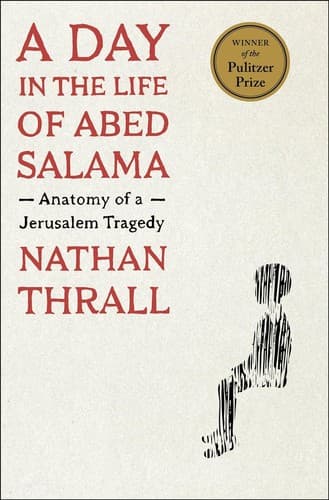
Core Idea
- The book uses the 2012 school-bus fire near Jerusalem to show how occupation is not an abstract political condition but a daily system of walls, IDs, checkpoints, road design, permits, and divided emergency services that shapes who can move, be rescued, or even be counted.
- The tragedy is inseparable from the wider history of Jerusalem’s fragmentation: the separation barrier, settlement expansion, and bureaucratic categories turned nearby Palestinian neighborhoods into neglected enclaves while making rescue, schooling, work, and family life precarious.
- Thrall links one disaster to the larger Palestinian experience of being trapped between Israeli control, Palestinian factionalism, and the long aftermath of Oslo, which produced not peace but a more intricate geography of confinement.
Abed Salama and the Human Cost of Confinement
- The opening follows Abed Salama on the morning of the crash as he learns that his five-year-old son Milad is on a burning bus and must race through a landscape of checkpoints, settlements, and severed roads.
- Abed’s life is shaped by the social and political constraints of Anata: family honor, arranged marriage pressures, and the way Israeli rule carved up land, class, and movement.
- His secret love for Ghazl is made possible only through improvised communication, and it ends because of pride, manipulation, and the lack of any stable private life under occupation.
- Abed’s political coming-of-age comes through the First Intifada, DFLP organizing, clandestine bayanaat, and the constant danger of informants, arrests, and intra-Palestinian violence.
- His 1989 arrest and years in prison show how the Israeli security system works through torture, factional sorting, and the green ID regime that marks former prisoners and restricts movement long after release.
- Adult life remains fragmented: he works multiple jobs, is separated from home, considers polygamy or a marriage to a woman with a blue Jerusalem ID for practical survival, and ends up in a marriage that feels like inherited disappointment.
- Thrall uses Abed’s private losses to show how occupation reshapes ordinary life into a series of compromised choices rather than a single dramatic confrontation.
Huda Dahbour, Oslo, and the Politics of Return
- Huda Dahbour provides a parallel life story rooted in the Nakba, exile from Haifa, camp life in Syria, and family memory as a substitute for a lost homeland.
- Her identity is built through nationalist commitment, work for the Palestine Red Crescent, and a belief that even medical work is part of the struggle for Palestine.
- The 1985 bombing of the Palestinian leadership in Tunis becomes a turning point in her understanding of how violence can push Palestinian politics toward compromise.
- After Oslo, Huda returns to the West Bank to “replant a seed,” but finds that return does not restore sovereignty; it places her amid corruption, surveillance, unemployment, and a new elite of returnees who manage rather than liberate.
- Her family story also becomes a prison story: her son Hadi is arrested, tortured, convicted in military court, and used to reveal the broader machinery of Palestinian confinement.
- Huda’s hospital and prison experiences show how occupation invades the intimate sphere through searches, glass partitions, concessions extracted under pressure, and the permanent anxiety of not knowing where a child or spouse is held.
How the Landscape Was Engineered
- Colonel Saar Tzur and cartographer Dany Tirza represent the Israeli state’s spatial strategy: not just security, but redesigning territory to separate settlers from Palestinians while preserving Israeli control.
- Tirza’s work on bypass roads, “sterile roads,” and the fabric of life roads for Palestinians is presented as the material implementation of Oslo’s fragmentation.
- The book emphasizes that Area A, B, and C were not neutral administrative labels but a system that turned autonomy into cantons, with Area C holding most land, roads, settlements, and military zones.
- The separation barrier is described as the largest infrastructure project in Israel’s history and a decisive tool for reorganizing movement, often enclosing settlements while cutting off Palestinian neighborhoods from Jerusalem.
- Saar argues that walls and easing measures reduced attacks and made his job easier, especially when paired with transactional coordination through figures like Ibrahim Salama.
- Thrall does not present this as simple security success: the same system produced enclaves like Shuafat Camp and Dahiyat a-Salaam, where services collapse, emergency access is delayed, and lawlessness spreads.
- The book stresses that the barrier’s route often followed political and demographic priorities rather than a clean border, leaving tens of thousands of Palestinians outside municipal Jerusalem while avoiding the political cost of mass revocation of blue IDs.
The School Bus Crash as a Concentrated History
- The accident itself is traced through negligence, weather, speed, vehicle failure, and chaotic school logistics, but Thrall insists that these proximate causes operated inside a structurally dangerous environment.
- The route to the crash site is slowed by roadblocks, conflicting jurisdictions, and the general incapacity of the system to respond quickly across the wall and through checkpoints.
- Rescue becomes a study in divided sovereignties: Palestinian medics, Israeli responders, soldiers, fire crews, ZAKA volunteers, and hospital staff all arrive with different mandates, identities, and limits.
- Huda, Salem, Nader Morrar, Eldad Benshtein, and others are overwhelmed by the same scene but are filtered through different institutions, languages, and permissions.
- The hospital aftermath shows that even mass casualty care is structured by ID status, checkpoint access, and translation, with parents waiting to identify burned clothes and children, and staff trying to reconcile medical urgency with bureaucratic division.
- The crash therefore becomes an anatomy of Jerusalem itself: a place where infrastructure, jurisdiction, and human vulnerability collide.
What To Take Away
- The book’s core claim is that the tragedy of Milad Salama was produced by a system, not a single mistake.
- Israeli control appears most powerfully in ordinary logistics: roads, IDs, enclaves, and emergency response, not only in raids or war.
- Palestinian lives are also shaped by internal divisions, family politics, factional violence, and the long disillusionment of Oslo.
- Thrall’s method is to turn one day into a map of an entire political order, where the distance between home, school, hospital, and prison is measured in power as much as in miles.
Generated with GPT-5.4 Mini · prompt 2026-05-11-v6