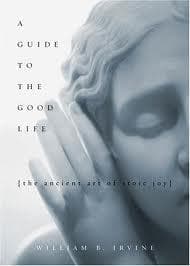
Core Idea
- Irvine treats philosophy as a plan for living: it needs a grand goal and a strategy for reaching it.
- His claim is that Stoicism is a powerful life-plan for people who want less anxiety, less grief, less anger, and more durable joy.
- Stoicism is not emotionlessness; its aim is to eliminate negative emotions while preserving joy, cheerfulness, and active engagement with life.
What Stoicism Is, and Why Irvine Thinks It Matters
- Ancient philosophy was practical and therapeutic, unlike most modern academic philosophy, which largely ignores “philosophy of life.”
- The Stoics—beginning with Zeno and developed especially by Seneca, Musonius Rufus, Epictetus, and Marcus Aurelius—saw philosophy as training for living well.
- Stoic ethics is eudaemonistic: the point is flourishing, not rule-following for its own sake.
- Virtue means excellence as a human being, i.e. living in accordance with nature, reason, and our social character.
- The Stoic sage is the ideal: free from vanity, grief, and unworthy passions, yet active, dutiful, and socially engaged.
- Irvine emphasizes that Roman Stoicism gives special weight to tranquility because it makes virtue easier and is more attractive to ordinary people.
- He also argues Stoicism remains relevant because human psychology has changed little in 2,000 years, even if modern philosophy has lost sight of it.
- He presents Stoicism as compatible with many religions, but also workable for agnostics.
The Main Techniques: How Stoicism Works
- Negative visualization is the habit of imagining the loss of things one values—wife, children, health, possessions, work—so they are appreciated more while present.
- Its target is hedonic adaptation: the way people quickly return to baseline dissatisfaction after getting what they wanted.
- The practice is meant to produce gratitude, joy, and less clinging, not gloom; even the homeless person can use it by imagining losing what little remains.
- Irvine links this to daily habits like saying grace, and to Stoic reminders that loved ones and possessions are temporary loans from Fortune.
- Dichotomy of control becomes, in Irvine’s presentation, a trichotomy: things under full control, things outside control, and things only partly controllable.
- The key Stoic move is to focus on what is fully under one’s control—judgment, values, character—and to stop worrying about what is not.
- For mixed-control activities, Irvine stresses internalized goals: aim to play well, act lovingly, or prepare well, rather than to guarantee an external result.
- Stoic fatalism is mainly about the past and present: accept what has happened, and do not waste energy on “if only” rumination.
- Voluntary discomfort or “practice poverty” trains resilience and appreciation by periodically choosing cold, hunger, hard beds, simple clothes, or other discomforts.
- The point is not masochism; it is to harden oneself against misfortune, prove one can endure, and reduce dependence on pleasure.
- Stoic self-review is a nightly or regular meditation on one’s day: what went well, what failed, what needs correction.
- Progress is measured by reduced sensitivity to insult and praise, less blame and boasting, fewer desires, and more tranquility and occasional joy.
Social Life, Status, Sex, Death, and the Limits of the Project
- Stoicism is not antisocial: humans are naturally social, and duty requires living with and for others.
- But social life is dangerous to tranquility, so friendship should be selective; corrupted values and chronic complaint are contagious.
- Marcus Aurelius advises tolerating annoying people by remembering that others are annoying too, and by shrinking their importance in cosmic perspective.
- Stoic treatment of insults starts by asking whether the insult is true, whether the insulter meant harm, and whether the source deserves weight.
- The preferred response is often humor, calm nonresponse, or, when necessary, corrective punishment without anger.
- Anger is “brief insanity” and anti-joy; the Stoic aim is to correct wrongs without being governed by rage.
- On grief, the Stoics do not demand numbness; they allow natural sorrow but seek to prevent excess, self-pity, and “if only” regret.
- On sex, the Roman Stoics are unusually strict: Musonius and Epictetus favor chastity outside marriage, and Marcus reduces lust to bodily mechanics.
- Yet they strongly endorse marriage and family life as genuine sources of happiness and duty.
- Stoics are deeply suspicious of fame and wealth because both give other people power over us and encourage us to live by their values.
- Their ideal is simple living: enough money to avoid poverty, but not luxury; enough public standing to serve, but not to crave applause.
- Exile, old age, and death are recurring tests of the philosophy: none can take away virtue, and each can be met with composure.
- Stoicism does not forbid suicide in all cases, but treats it as a serious option only when continued life cannot serve duty or the common good.
- Irvine’s recurring point is that Stoicism is attractive because it turns hardship into training and makes joy less dependent on fortune.
What To Take Away
- Stoicism is a practical discipline for reducing the power of negative emotions and increasing secure joy.
- Its central methods are negative visualization, control discipline, internalized goals, voluntary discomfort, and regular self-review.
- The philosophy asks you to value virtue, accept what you cannot control, and stop treating wealth, fame, comfort, and other externals as ultimate goods.
- Irvine’s final claim is pragmatic rather than doctrinal: Stoicism may not be the only good philosophy of life, but for some people it can genuinely become a whole new life.
Generated with GPT-5.4 Mini · prompt 2026-05-11-v6