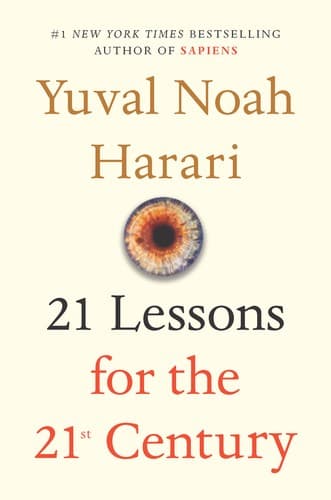
Core Idea
- Harari treats the book as a map of the present: how to stay clear-minded amid information overload and how to think about the future without pretending to solve everything.
- His central claim is that the merger of infotech and biotech is the defining challenge of the 21st century because it can reshape jobs, bodies, minds, freedom, equality, and politics.
- He emphasizes risks over triumphs: the danger is not just smarter machines, but humans becoming easier to manipulate, exclude, and govern through data.
The Big Pressures: Technology, Jobs, and Power
- Harari argues that AI and automation may destroy not only blue-collar work but many cognitive jobs too, because machines increasingly beat humans at pattern recognition, emotional inference, and decision-making.
- The classic industrial promise—that lost jobs will be replaced by new ones—may fail this time, creating a “useless class” of people who cannot easily retrain into high-skill work.
- He repeatedly stresses that the right goal is to protect people, not jobs, and that slowing automation or cushioning transitions may require regulation, lifelong education, and a stronger safety net.
- If mass unemployment arrives, Harari surveys post-work responses such as universal basic income, universal basic services, and broader definitions of socially valuable work like care and community labor.
- He warns that UBI and similar support may improve material conditions without automatically producing satisfaction, because human contentment depends on expectations, status, and meaning.
- The deeper long-term danger is a shift in authority from humans to algorithms: systems that know our preferences, moods, health, and vulnerabilities better than we do.
One Global Civilization, Not a Clash of Civilizations
- Harari rejects the idea of separate civilizational blocks; he argues there is effectively one global civilization built from shared political, economic, and scientific systems.
- Modern politics has converged on the model of sovereign states, elections, rights, diplomacy, and international law; modern economics on global capitalism; modern medicine and science on one shared paradigm.
- What look like civilizational clashes are usually internal conflicts within a common global order, not encounters between sealed historical worlds.
- Nationalism is presented as a modern construction that helped solve large-scale coordination problems, but becomes dangerous when it turns into chauvinism and zero-sum identity politics.
- Harari notes that global threats such as climate change, AI, bioengineering, and nuclear weapons make nationalism structurally inadequate, because the harms and solutions cross borders.
- He uses climate change and clean meat as examples: some countries may benefit from fossil fuels or warming, but no country can solve the biosphere crisis alone.
- Religion matters most, in his account, as an identity technology; it draws boundaries between “us” and “them,” and modern states often fuse religion with nationalism.
- He treats terrorism as a strategy that relies on fear, not material destruction, and argues that overreaction gives terrorists the influence they seek.
Truth, Liberalism, and the Post-Truth Mind
- Harari sees liberalism as the strongest political model humans have developed, but one now under strain from economic dislocation, nationalism, and technological manipulation.
- Liberal democracy depends on the idea that individuals can trust their own feelings and choices, yet that assumption weakens if technology can hack emotions and preferences.
- He argues that truth is a core secular value: it rests on observation and evidence rather than sacred authority, and it matters because compassion without truth is blind.
- The book’s critique of post-truth is that humans are already a post-truth species, because our cooperation has always depended on shared fictions like money, nations, corporations, and holy books.
- Harari’s point is not that all stories are bad, but that humans often prefer power to truth and confuse useful collective myths with reality.
- He distinguishes between the brain and the mind: brain science can observe neural activity, but subjective consciousness remains poorly understood and scientifically mysterious.
- Because of that mystery, he thinks the more immediate danger is not conscious AI rebellion, but super-intelligent systems serving human stupidity, bias, and cruelty.
- He also fears “digital dictatorship,” where centralized regimes use surveillance, biometric data, and machine learning to know what citizens feel and to shape those feelings at scale.
Meaning, Story, and Meditation
- Harari argues that humans constantly seek meaning through stories—religious, national, ideological, romantic—but every such story is partial and bounded.
- He rejects the idea that nations, religions, or historical projects are literally eternal; only individuals suffer, while collective entities are narrative constructions.
- His ethical bottom line is that suffering is the most concrete reality we can rely on, so morality should start from observing and reducing suffering rather than from grand abstractions like purity, eternity, or redemption.
- In the later chapters he lays out a positive secular code built on truth, compassion, equality, freedom, courage, and responsibility.
- He insists secularism is not mere nonbelief; it is an ethical framework that can include religious people so long as they accept the secular commitment to evidence and human accountability.
- He warns, however, that secularism can itself become dogmatic, just as Stalinism, capitalism, and even human rights language can harden into slogans that ignore reality.
- His own practical answer to the question of mind and suffering is Vipassana meditation, which he presents as a disciplined method of directly observing breath, sensation, craving, and aversion.
- Meditation leads him to the claim that the self is not a stable essence but a changing bundle of sensations, reactions, and narratives; the “inner narrator” is itself a constructed story.
- He closes by urging readers to understand their minds before algorithms do it for them: if we do not know how attention, desire, and selfhood work, others will learn to manipulate them first.
What To Take Away
- The book is a warning that 21st-century power will come from data, biology, and algorithms more than from armies or ideology.
- Harari thinks the main political task is to build institutions that can handle global problems without letting fear, nostalgia, or techno-euphoria take over.
- He wants readers to treat identity stories with caution and to anchor ethics in real suffering, not in sacred narratives or collective self-flattery.
- His deepest practical message is that self-knowledge is a form of defense: if humans do not learn how their minds work, they may become subjects of systems they do not understand.
Generated with GPT-5.4 Mini · prompt 2026-05-11-v6