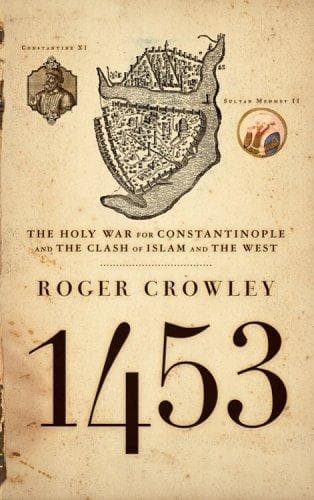
Core Idea
- Crowley treats the fall of Constantinople in 1453 as the decisive culmination of an 800-year Islamic-Christian struggle, not a simple ethnic clash between Greeks and Turks.
- The book’s central tension is between a city whose geography, sacred status, and imperial prestige made it the “city of the world’s desire” and an Ottoman power that combined holy war, statecraft, logistics, artillery, and ruthless succession politics to take it.
- Constantinople’s fall matters because it ended Byzantium, transformed Ottoman imperial identity, and helped harden the West’s image of the “Turk” as a permanent civilizational enemy.
Why Constantinople Mattered
- Constantinople was unusually defensible: a triangular peninsula protected by the sea, the Golden Horn chain, and the Theodosian walls, the strongest medieval land fortification system.
- Yet it was also uniquely vulnerable because its wealth, trade routes, grain supply, and legitimacy made it a permanent target for empire-builders and holy warriors.
- Crowley stresses that both Byzantium and Islam were universalizing religions, but they expressed that universality differently: Orthodox Byzantium through relics, liturgy, icons, and imperial ritual; Islam through a more portable, austere sacred order.
- The city’s political and spiritual life was saturated with prophecy, omens, icons, relics, earthquakes, and portents, so siege pressure was interpreted in both military and apocalyptic terms.
- The earlier Arab sieges of 674–678 and 717–718 mattered because they fixed Constantinople as an enduring Muslim objective and made Byzantine survival seem miraculous, especially after Greek fire shattered attackers’ morale.
- The later Ottoman push was enabled by Byzantine weakness after Manzikert, the 1204 Fourth Crusade, plague, civil war, and shrinking population, which turned the empire into a brittle remnant.
The Ottoman Road to 1453
- Crowley presents the Ottomans as a multicultural, adaptive empire-in-the-making that borrowed Byzantine institutions, attracted gazi fighters, and fused tribal steppe culture with Persianate court forms and Islamic legitimacy.
- Mehmet II is the book’s key personality: brilliantly educated, multilingual, historically minded, and raised in a brutal succession system where fratricide and palace violence were normal.
- Mehmet saw Constantinople as both a religious prize and a world-historical conquest, modeling himself on figures like Alexander and Caesar while embracing the Red Apple myth of eventual capture.
- His accession in 1451 was immediately ruthless and strategic: he eliminated rivals, managed diplomacy to lull neighbors, and then prepared war with obsessive seriousness.
- The decisive strategic move was Rumeli Hisari on the Bosphorus, which choked Constantinople’s lifeline from the Black Sea and showed Mehmet’s skill at using geography as a weapon.
- Ottoman siege capacity was fundamentally changed by gunpowder: corned powder, huge bombards, battlefield foundries, and a supply system that drew copper, saltpeter, sulfur, tin, and labor from across the empire.
- The most famous example is Orban’s supergun, cast for Mehmet after the Byzantines could not adequately fund or use him; its test firing became psychological warfare before the siege even began.
- Mehmet’s army was vast, multinational, and carefully organized: Janissaries, sipahis, azaps, Christian auxiliaries, engineers, merchants, craftsmen, and supply teams all formed part of the war machine.
The Siege, the Split, and the Fall
- Constantine XI defended a city with only a tiny force—roughly 4,773 Greeks, a few hundred foreigners, and limited reserves—while trying to preserve morale, supplies, and unity among Greeks, Venetians, Genoese, and Galata.
- Giustiniani’s arrival strengthened the defense tactically, but the city’s deepest weakness was the gap between its mythic walls and its actual manpower.
- Crowley highlights how warfare on the land walls became an artillery contest: the Lycus valley and Romanus Gate sector took the worst punishment, while defenders improvised with earth banks, timber, barrels, and night repairs.
- Mehmet’s army did not rely on one tactic; it combined bombardment, mining, naval pressure, psychological intimidation, and eventually the transport of ships overland into the Horn, which transformed the siege by making the harbor unsafe.
- Internal Christian conflict repeatedly weakened defense efforts: Venetians and Genoese blamed one another, Galata was suspected of duplicity, and the hoped-for Western relief never arrived in time.
- Religious division inside the city also mattered; the Union of Florence was politically necessary for Constantine but spiritually toxic to many Orthodox, who saw Latin aid as betrayal after 1204.
- The final days are framed as a battle of endurance under signs of doom: earthquakes, bad weather, eclipses, omens, failing food, desertion, and apocalyptic readings on both sides.
- Mehmet’s final assault on May 29 was a staged sequence: expendable irregulars, then Anatolians, then Janissaries, with drums, cannon, arrows, and pressure along both land and sea walls.
- The defense collapsed after a cluster of contingencies, especially the wounding and withdrawal of Giustiniani, the opening of a postern gate, and the flood of Janissaries into the breached enclosure.
- Crowley emphasizes the uncertain fate of Constantine XI; the lack of reliable eyewitness testimony helped turn him into a martyr-figure and a durable Greek legend.
- Mehmet entered St. Sophia, halted the looting, converted the church into a mosque, and symbolically transformed the city from Byzantine capital into Ottoman imperial center.
Aftermath, Memory, and History
- The immediate aftermath was brutal: mass enslavement, deportation, elite executions, hostage-taking, and the destruction or conversion of churches and sacred objects.
- Yet Crowley insists Mehmet was not simply a destroyer; he rebuilt Constantinople as Istanbul, resettled populations, protected Galata, restored the patriarchate under restrictions, and ruled a multicultural empire that tolerated difference more than many Western states of the period.
- The fall sent shockwaves through Europe, especially Venice, where the news was received like an existential catastrophe, while in the Islamic world it was celebrated as the fulfillment of prophecy and a sign of future expansion.
- Crowley argues that 1453 concentrated and hardened European anti-Turkish propaganda, helped create the enduring image of the Ottoman as a barbaric enemy, and became a long-term reference point for crusade rhetoric and later nationalism.
- At the same time, the book repeatedly warns that the surviving source base is biased and fragmentary: most eyewitnesses are Christian, many accounts are partisan, and some famous texts are later reconstructions or forgeries.
- The lasting historical irony is that Constantinople’s fall ended one world and began another: a ruined Byzantine center became the brilliant Ottoman capital, while the memory of the fallen city continued to shape Greek, European, and Islamic politics for centuries.
What To Take Away
- The fall of Constantinople was not a single battle but the collision of geography, theology, artillery, logistics, and political fragmentation.
- Mehmet II succeeded because he matched ideology with systems: blockade, cannon, infrastructure, and disciplined command made his holy-war ambition executable.
- Byzantium’s tragedy was not just military weakness but the inability to unify internally or secure reliable outside help when the siege became final.
- Crowley’s larger point is that 1453 was a hinge event: it ended Byzantium, remade Ottoman power, and helped define how Europe and Islam imagined each other thereafter.
Generated with GPT-5.4 Mini · prompt 2026-05-11-v6