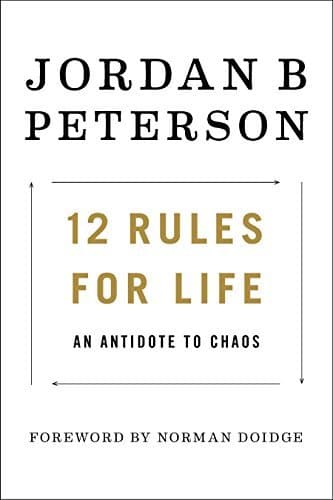
Core Idea
- Peterson’s core claim is that meaning, not happiness, is the proper aim of life, and meaning is found by taking responsibility at the border between order and chaos.
- The book treats suffering, hierarchy, and the human capacity for evil as unavoidable facts of life, then argues that disciplined truth-telling, self-correction, and sacrifice can keep those facts from turning into nihilism or tyranny.
- The “12 rules” are not soft suggestions but practical and moral disciplines meant to help a person become more reliable, courageous, and life-giving in a world that can quickly collapse into disorder.
Order, Chaos, and Human Nature
- Peterson’s symbolic framework opposes order—the known, structured, socially legible world—to chaos—the unknown, betrayal, illness, collapse, and the formless potential of change.
- He treats order and chaos as nearly living realities, often coded as masculine/feminine, Father/Mother, or explored territory/home territory, with meaning arising on their boundary rather than in either extreme.
- Genesis is read as an archetypal account of consciousness: the Fall brings self-awareness, shame, mortality, and the knowledge that humans can deliberately inflict suffering.
- He defends Original Sin as psychologically plausible because people know their own corruptibility and are capable of choosing evil, not just of being mistakenly socialized.
- Evil, in this account, is specifically human: the capacity to plan and produce suffering for its own sake, as in torture, vengeance, or ideological cruelty.
- Peterson contrasts this with his broader claim that people are also capable of bringing order out of chaos through truthful speech, conscious choice, and responsibility.
The Rules as Character Formation
- Rule 1: Stand up straight with your shoulders back uses lobsters and dominance hierarchies to argue that status competition is ancient, biological, and linked to posture, confidence, and serotonin.
- Winning and defeat alter body and mind in feedback loops, so upright posture is both literal and symbolic: it means voluntarily accepting the burden of Being and acting courageously.
- Rule 2: Treat yourself like someone you are responsible for helping argues that people often care for pets better than themselves and neglect their own future through self-betrayal.
- He frames self-care as truthfulness and respect rather than indulgence: define where you are going, keep promises to yourself, and act as though your own being matters.
- Rule 3: Make friends with people who want the best for you is about reciprocal upward movement, not sentimental loyalty; companions should support responsibility rather than normalize stagnation or resentment.
- Rule 4: Compare yourself to who you were yesterday, not to who someone else is today rejects status panic in a world of extreme visible comparison and instead measures growth against your own prior self.
- He says adulthood means negotiating with yourself, not tyrannizing yourself, and choosing better “games” rather than accepting a single humiliating scoreboard.
- Rule 5: Do not let your children do anything that makes you dislike them treats discipline as the minimum necessary force required to make children socially competent and desirable to other people.
- Overprotection is dangerous because it leaves children weak, dependent, and unable to tolerate reality; the world will discipline them more harshly if parents refuse to.
- Rule 6: Set your house in perfect order before you criticize the world directs attention to self-repair first, because cynicism about the world can hide one’s own contribution to disorder.
- He uses mass-murder ideologies, catastrophe, and Biblical cycles of warning/collapse/repentance to argue that blaming society is not a substitute for cleaning up one’s own life.
- Rule 7: Pursue what is meaningful (not what is expedient) opposes short-term gratification and self-protection to sacrifice, work, reciprocity, and the future-oriented good.
- Meaning, for Peterson, is what aligns present effort with a larger order of life; expediency is cowardice that transfers burden forward and makes the future worse.
- Rule 8: Tell the truth—or, at least, don’t lie is his strongest anti-ideological rule: lies corrode the self, distort institutions, and scale up into totalitarian politics.
- He contrasts honest speech with “life-lies,” willful blindness, and ideologies that force reality into a preselected theory; truth makes relationships and reality habitable.
- Rule 9: Assume that the person you are listening to might know something you don’t defines conversation as mutual exploration, not dominance, advice-giving, or ideological performance.
- Listening is practical and therapeutic because people think by speaking; genuine dialogue helps sort experience, exposes false stories, and keeps the mind sane.
Precision, Risk, and Tragic Hope
- Rule 10: Be precise in your speech says vague language lets chaos spread, while exact speech helps identify what is actually wrong and what can be changed.
- His examples of betrayal, marriage conflict, and medical diagnosis show that unnamed problems grow like dragons under the carpet until they destroy trust and identity.
- Rule 11: Do not bother children when they are skateboarding argues that healthy development requires risk, competence, and challenge, not sterile safety.
- He extends this into a critique of overprotection, resentment, and anti-human moralism, warning that contempt for masculinity, hierarchy, or ambition can collapse into self-hatred and nihilism.
- Rule 12: Pet a cat when you encounter one on the street is a small but serious antidote to despair: brief contact with ordinary being can restore wonder and interrupt bitterness.
- The closing sections use suffering in family life, illness, and mortality to argue that limitation is part of what makes life meaningful; without vulnerability there is no story, love, or character.
- His final symbolic move is modest but forceful: aim for the highest good, but concentrate on today, and take the next right step in the face of inevitable catastrophe.
What To Take Away
- The book’s unifying claim is that responsibility is the path through chaos, not comfort, certainty, or ideological purity.
- Peterson thinks moral and psychological health depend on truthfulness, discipline, and voluntary sacrifice, because the alternative is resentment, tyranny, or collapse.
- Many of the rules are really about becoming someone others can rely on: socially competent, hard to corrupt, and capable of sustaining order in yourself and in your relationships.
- The ending is not triumphalist but sober: life remains tragic, yet it is still good enough to affirm, provided you keep your aim high and do the next right thing.
Generated with GPT-5.4 Mini · prompt 2026-05-11-v6