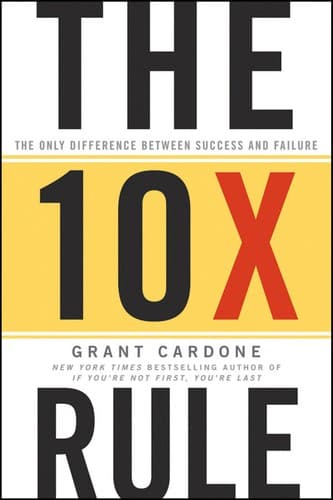
Core Idea
- The book’s central claim is that extraordinary success requires the 10X Rule: set goals 10 times bigger than what seems reasonable and take 10 times more action than you think is necessary.
- Cardone argues success is not a matter of talent, education, luck, or personality, but of disciplined, repeated massive action and enlarged thinking.
- The main failure mode is not lack of effort alone, but thinking too small, underestimating adversity, and accepting “normal” outcomes.
How Success Actually Works
- Cardone defines success as getting a desired result and then maintaining, multiplying, and repeating the actions that produced it.
- He rejects the idea that success is scarce or zero-sum; many people can succeed at once without limiting each other.
- He says common goal-setting errors are mistargeting too low, underestimating resources and actions, competing instead of dominating, and underestimating adversity.
- The book treats “wanting more” in money, health, relationships, and contribution as legitimate, and says limiting your own ambition also limits your effort.
- Cardone criticizes “just enough” and middle-class thinking as a trap that creates dependence, vulnerability, and mediocrity.
- He argues that massive action is the only reliable path to exceptional results, because normal action produces only an average life.
- He presents four degrees of action: do nothing, retreat, normal action, and massive action; even inaction and retreat are still forms of effort.
- Massive action is said to attract criticism, but that criticism is treated as evidence that you are operating beyond the norm.
- Obsession is reframed positively: persistent focus on a goal is necessary for greatness, and “going all in” means committing energy, creativity, persistence, and ideas, not just money.
Behaviors and Mindsets That Separate Winners
- Fear should trigger action, because most fear is “False Events Appearing Real” and grows when fed by hesitation.
- Time management is called a myth; the real issue is priority management, meaning controlling time around the highest priorities.
- Excuses are dismissed as self-protective stories, not real causes; Cardone repeatedly insists, “Nothing happens to you; it happens because of you.”
- Successful people are said to share habits and attitudes: “can do” thinking, “I will figure it out,” and a preference for solutions over complaints.
- They treat problems and downturns as opportunities, because challenge creates openings for products, customers, money, and growth.
- Persistence, risk-taking, willingness to be “unreasonable,” and comfort with being “dangerous” are framed as required for exceptional outcomes.
- Successful people focus on wealth creation through ideas, services, and solutions rather than just earning a salary.
- They say yes to opportunities, commit fully instead of “trying,” stay focused on the goal, and do not let traditional thinking define what is possible.
- Cardone also emphasizes ethics as fulfilling commitments and living up to your potential, not merely avoiding illegal acts.
- Continuous learning, discomfort, and reaching up in relationships are presented as part of the discipline of 10X living.
Attention, Criticism, Customers, and Omnipresence
- Criticism is portrayed as a normal byproduct of success and visibility, and often comes from threatened or inactive people.
- His response to criticism is not defense but more success; he sees public attention as proof that you matter.
- He argues that customer acquisition matters before customer satisfaction, because there can be no satisfaction without customers.
- Complaints are not a failure state but a source of information about where acquisition or service breaks down.
- He says businesses often hide behind “brand protection” or “customer satisfaction” when they have not actually attracted enough customers.
- He recommends making yourself and your brand omnipresent—everywhere, repeatedly, and across many channels—so your name becomes synonymous with the category.
- Omnipresence is illustrated with examples like Coca-Cola, Google, Apple, Oprah, Warren Buffett, Obama, and Elvis.
- His own strategy included books, video, blogs, radio, TV, social media, PR, and constant exposure, which he says led to more opportunities and recognition.
- He ties omnipresence to scale: helping one person is not enough when the world is so large, and a bigger mission fuels the required activity.
- He repeatedly argues that visibility itself creates momentum, and that obscurity, not criticism, is the real enemy.
Getting Started with 10X
- The practical starting point is to write the goal first, then list actions, and begin immediately rather than overthinking the “how.”
- If a goal feels overwhelming, start with one small action to get traction, but do not reduce the goal itself.
- Cardone’s own example is aiming to become synonymous with sales training, then using media, publishing, and relentless outreach to build visibility.
- He says he ignored discouragement about market saturation, weak book odds, and bad economics, and instead kept expanding activity even when it required personal sacrifice.
- He frames his later success as proof that 10X thinking plus massive action can work even in a difficult environment.
What To Take Away
- The book’s key distinction is not between hard work and laziness, but between normal effort and massive, sustained action aimed at huge targets.
- Cardone believes the biggest danger is not failure but small thinking, which shrinks both ambition and follow-through.
- Criticism, fear, excuses, and adverse conditions are all treated as normal inputs to be used, not reasons to stop.
- The enduring message is to build a life around big goals, visible presence, full commitment, and relentless execution.
Generated with GPT-5.4 Mini · prompt 2026-05-11-v6